

Durable Medical Equipment

Your fleet, finally calm.
Every unit accounted for.

Calnedra.AI watches demand, price, stock and claims across your whole DME operation — so resupply arrives before a patient runs short, quotes go out priced to win, and clean claims leave the building the first time.

4.9 rated

By DME operations and billing teams

Care coordinator with a patient at homePatient with a rolling walker outside her homeAn older couple sitting together outdoors

Built for branches running 340+ rental units apiece

An older couple at home reviewing something together in a bright living room
  • Wheelchairs
  • Home Oxygen
  • CPAP & Masks
  • Hospital Beds
  • Mobility
  • Rentals
  • Resupply
  • Prior Auth
  • Repairs
  • HCPCS
  • Transfers
  • Clean Claims
One screen

Demand, stock, risk and confidence — together.

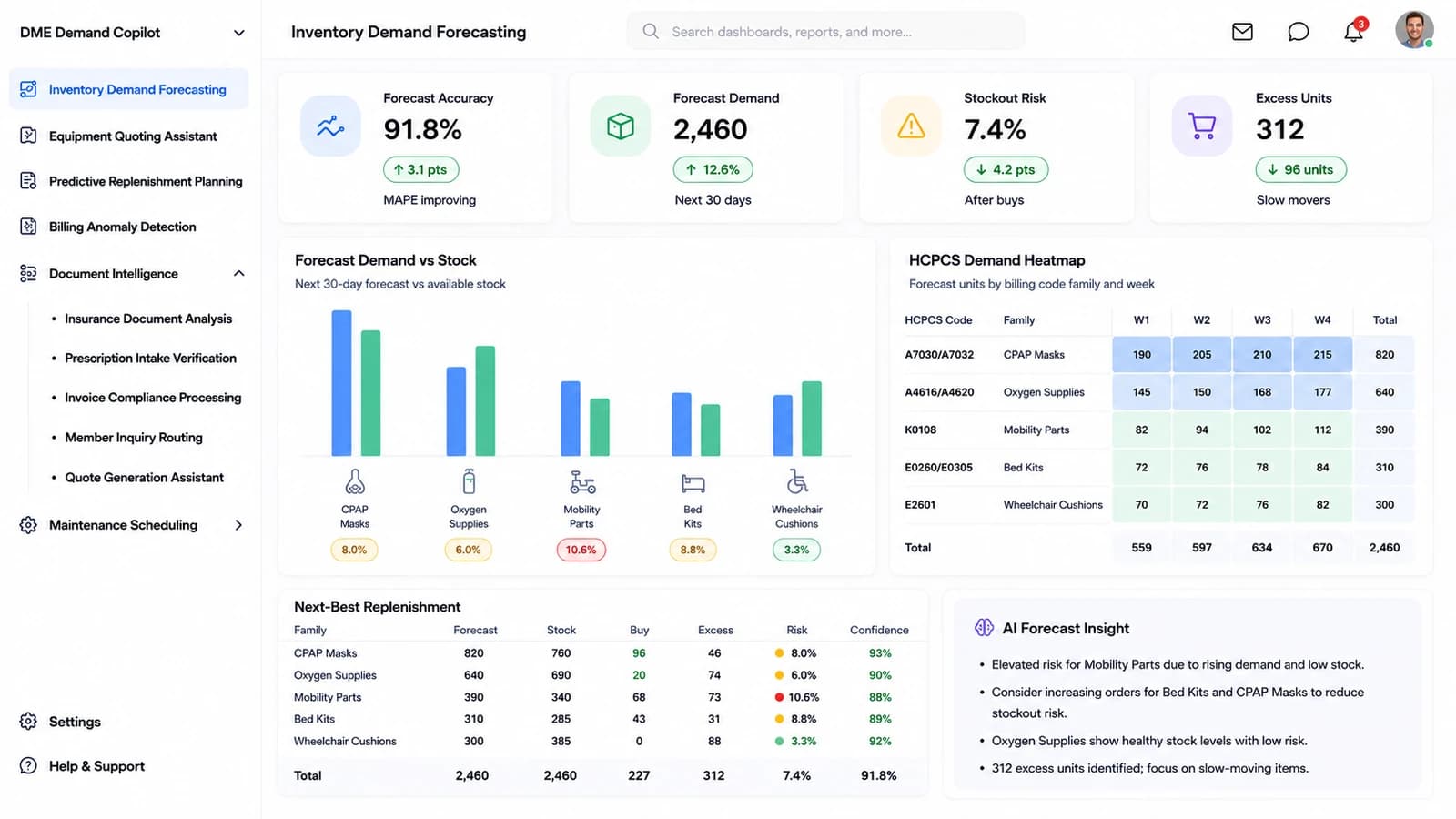
Calnedra.AI reads thirty days ahead across every HCPCS family you carry, then shows the forecast, the stock you actually hold, the risk of running short and the confidence behind each number — so a buy decision takes a minute, not a morning.

Calnedra.AI — Inventory Demand Forecasting dashboard showing forecast accuracy, HCPCS demand heatmap and next-best replenishment
91.8%
Forecast accuracy
MAPE improving · +3.1 pts
2,460
Units forecast
Next 30 days · +12.6%
7.4%
Stockout risk
After buys · down 4.2 pts
312
Excess units
Slow movers · down 96
A desk with a laptop and a stethoscope, where the morning buy list gets reviewed
AI forecast insight

“Elevated risk for mobility parts on rising demand and low stock. Increase orders for bed kits and CPAP masks to reduce stockout risk — and look at the 312 excess units sitting on slow movers.”

Written back to your buyers every morning, in the same HCPCS families they already order in.

The modules

How Calnedra.AI keeps the fleet moving

Six modules, one operating layer. Each one works in the codes, payers and equipment classes your team already lives in.

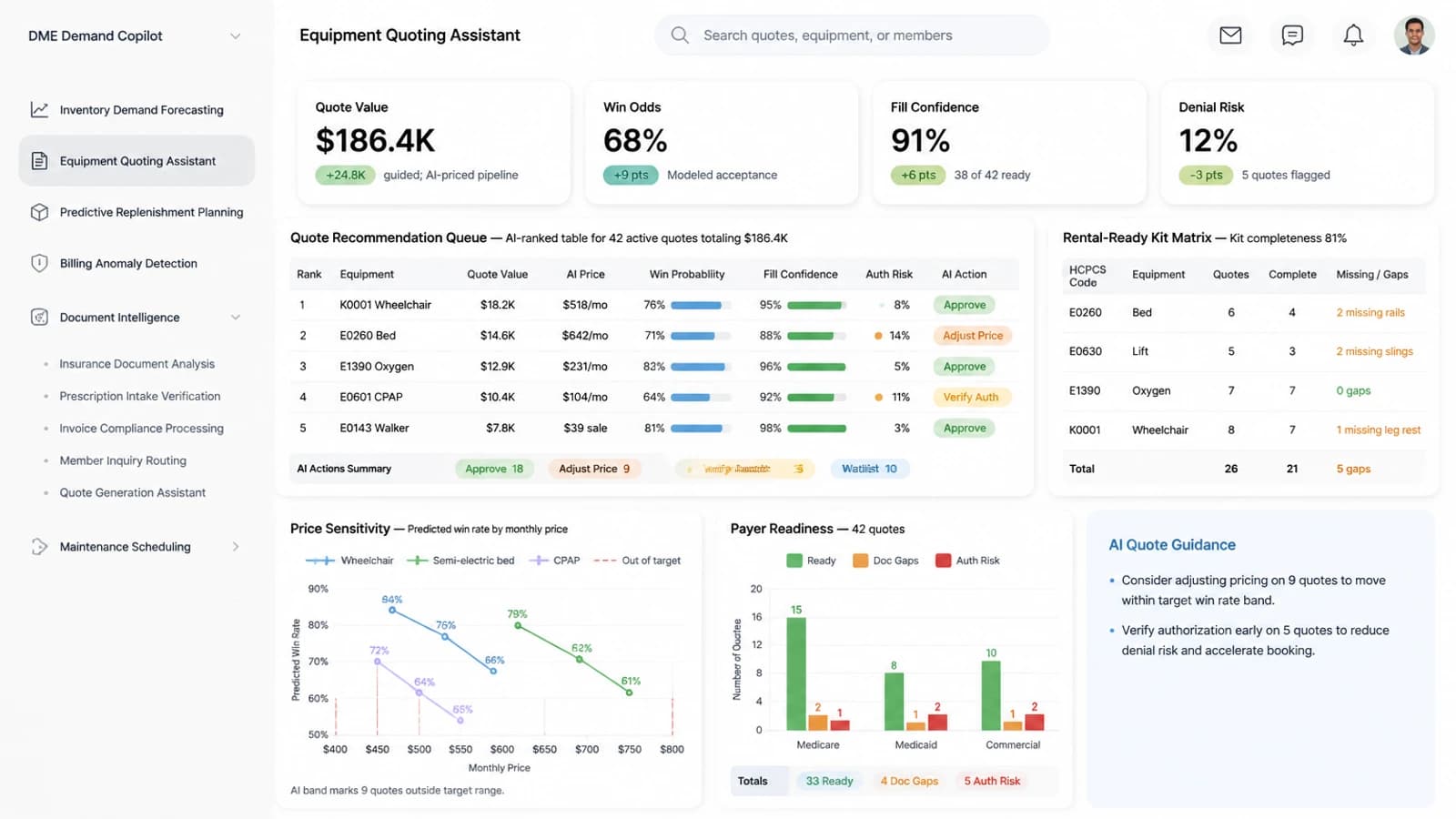
Calnedra.AI — Equipment Quoting Assistant dashboard with an AI-ranked quote queue, rental-ready kit matrix and payer readiness
02

Equipment Quoting Assistant

Every open quote ranked by what it is worth and what it will take to fill. Calnedra prices the line, models the odds of acceptance, checks the kit is actually rental-ready, and tells you which quotes need authorisation verified before they move.

Quote value in play
$186.4K
Modelled win odds
68%
Fill confidence
91% · 38 of 42 ready
03

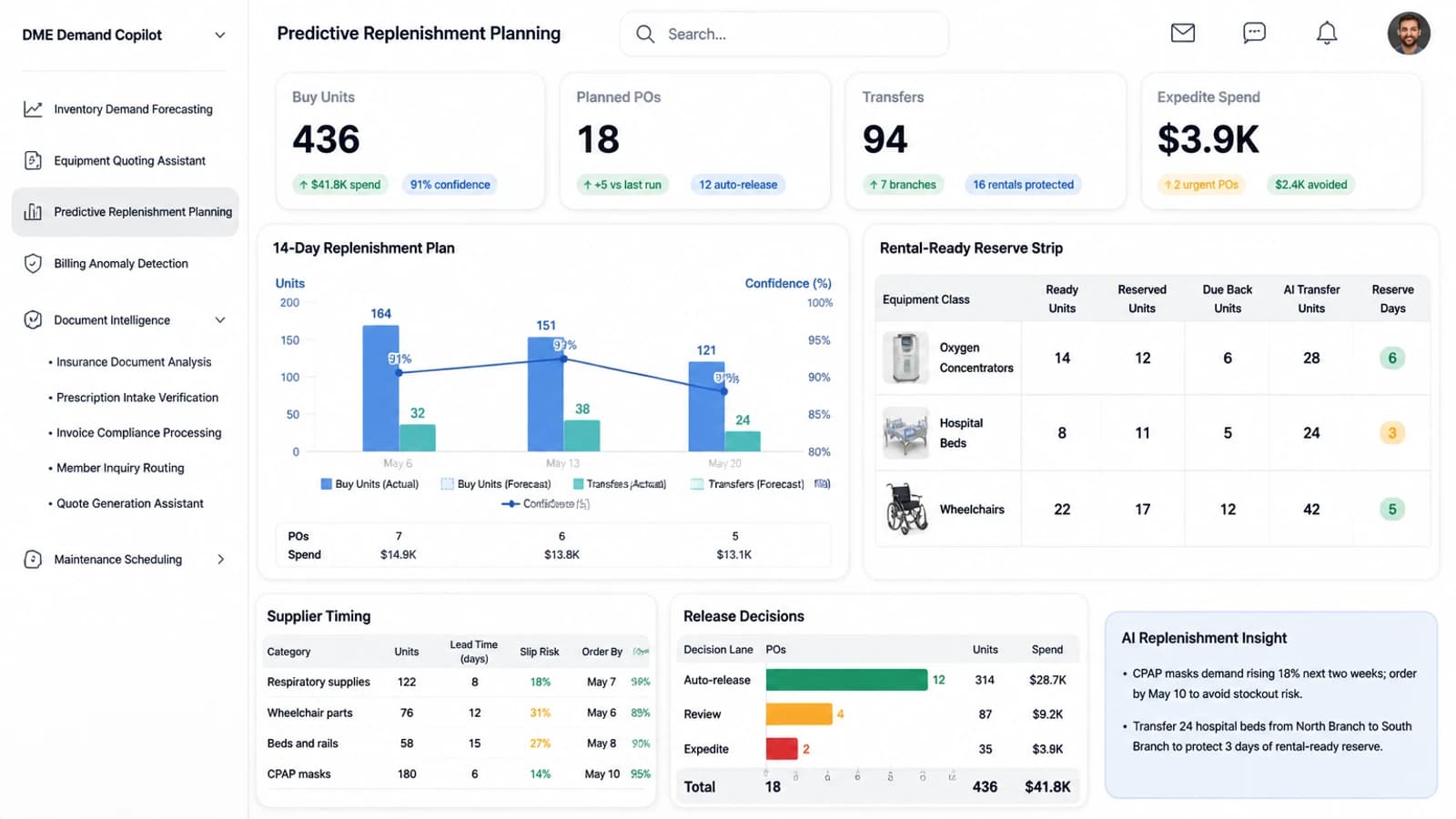
Predictive Replenishment Planning

A fortnight of buying laid out in advance — what to order, what to move between branches, and what can wait. Auto-release the safe lines, review the rest, and keep a rental-ready reserve behind every oxygen concentrator, bed and chair.

Buy units planned
436 · $41.8K
Transfers between branches
94 · 16 rentals protected
Expedite spend avoided
$2.4K
Calnedra.AI — Predictive Replenishment Planning dashboard with a 14-day plan, rental-ready reserve strip and supplier timing
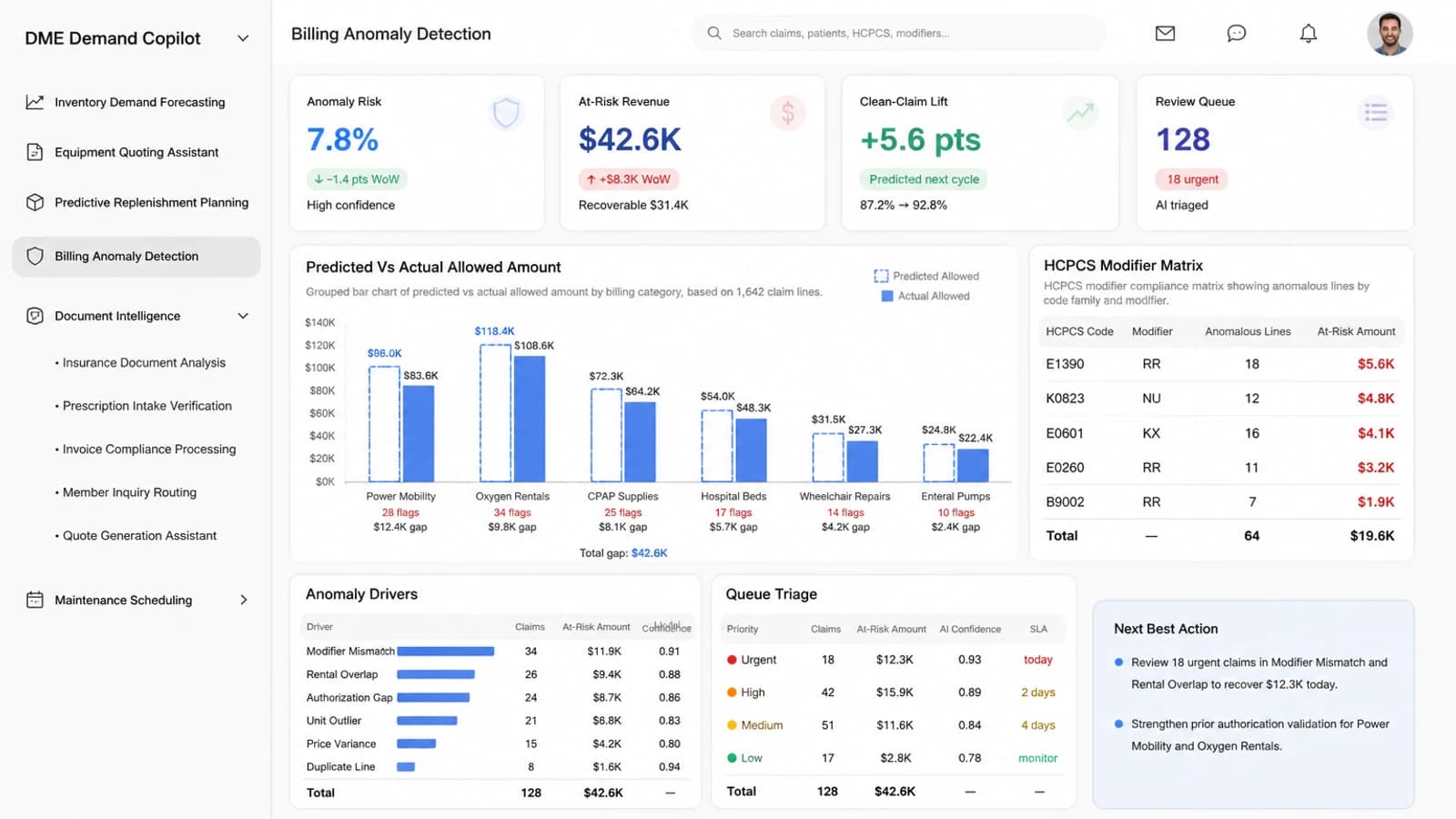
Calnedra.AI — Billing Anomaly Detection dashboard with predicted versus actual allowed amounts, an HCPCS modifier matrix and a triaged review queue
04

Billing Anomaly Detection

Claims are compared against what the payer should allow before they leave the building. Modifier mismatches, rental overlaps and authorisation gaps surface as a triaged queue, with the recoverable amount attached to each one.

At-risk revenue found
$42.6K · $31.4K recoverable
Clean-claim lift
+5.6 pts · 87.2% → 92.8%
Review queue
128 · 18 urgent

Document Intelligence

The paperwork layer of DME — orders, prescriptions, payer letters, supplier invoices and member questions — read, checked against the rules, and routed to whoever can actually close it.

  • Insurance Document Analysis
  • Prescription Intake Verification
  • Invoice Compliance Processing
  • Member Inquiry Routing
  • Quote Generation Assistant
A wall of service tools above a repair workbench

Maintenance Scheduling

Preventive service planned around real usage and battery health, not a fixed calendar — so a chair comes in for a pack before it strands someone, and the tech’s route makes sense.

How it works

Steadier in four short weeks

No programme, no consultants living in your office. Four steps, and most of the work is ours.

An older couple in a sunny front garden, one steadying herself on a rolling walker

Most providers see stockout risk and denial rate move inside the first two forecasting cycles.

  1. 01

    Connect what you already run

    Read-only links into your inventory, rental, billing and service systems. No migration, no rip-and-replace — usually live inside a day.

  2. 02

    Calnedra learns your operation

    It studies your demand by HCPCS family, your payers and denial patterns, your supplier lead times and your service history — your numbers, not an industry average.

  3. 03

    Your team works the queues

    Forecasts, ranked quotes, a fortnight of purchase orders, flagged claims and due services arrive as work already sorted by what it is worth.

  4. 04

    The numbers move, week over week

    Stockout risk falls, clean-claim rate climbs, expedite spend drops, and the rental-ready reserve behind each equipment class holds.

Why it holds up in a real branch

Forecasting is easy in a demo. These are the three things that make it survive a Monday.

An older couple sitting together on a bench by the water

It speaks HCPCS, not spreadsheets

Every forecast, quote and flag is expressed in the E-, K- and A-codes and RR / NU / KX modifiers your team already works in — nothing to translate.

It protects the rental-ready reserve

Planning is built around units that must stay available, so a buying decision never quietly strands a patient waiting on a chair or a concentrator.

It shows its confidence

Each number carries the model's confidence beside it, so your buyers know which lines to auto-release and which ones deserve a second look.

Voices from the floor

What changes for the people doing the work

Illustrative composites of how DME teams use Calnedra.AI — written to show the shape of the work, not quoted from named customers.

“The morning queue is the whole job now. I stopped building the buy list by hand — I review it, adjust two lines and release it.”
A branch operations managerMulti-branch DME provider
“Modifier mismatches used to come back to us six weeks later as denials. Now they come up before the claim goes out.”
A billing team leadRespiratory & mobility billing
“Battery health flags mean I swap a pack on a scheduled visit instead of driving out on an emergency at nine at night.”
A field service technicianPower mobility service

Accuracy

Numbers your buyers can defend to a supplier and a payer.

Readiness

The unit is there on the day the patient needs it.

Dignity

Behind every code is somebody waiting to get home.

Compliance

Built to the rules you are already held to

DME runs on paperwork that has to be exactly right. Calnedra.AI is designed around the regimes below — here is what it supports, and what each one actually covers.

  • HIPAA

    Health Insurance Portability and Accountability Act — Privacy & Security Rules (45 CFR Parts 160 & 164)

    Governs how patient health information is stored, accessed and shared; Calnedra keeps every record access-controlled, audited and encrypted.

  • 42 CFR 424.57

    Medicare DMEPOS Supplier Standards

    The 30 conditions a supplier must meet to hold Medicare billing privileges — Calnedra tracks the delivery, warranty and service evidence each one calls for.

  • 42 CFR 410.38

    Standard Written Order & Prior Authorization for DMEPOS

    Defines the order and prior-authorization paperwork required before an item ships; Document Intelligence reads each order and flags what is still missing.

  • HCPCS Level II

    Healthcare Common Procedure Coding System, Level II — DMEPOS codes & modifiers

    The E-, K- and A-code language of DME billing, with RR / NU / KX modifiers; forecasting, quoting and billing all work natively in these codes.

  • ASC X12N 837P

    HIPAA Electronic Health Care Claim — Professional (837P)

    The standard electronic claim format payers accept; Billing Anomaly Detection reviews claim lines in this shape before they leave your building.

  • 21 CFR Part 830

    FDA Unique Device Identification (UDI) System

    Requires each device to carry a unique identifier through its life; Calnedra holds UDI against every serialised unit for recalls and service history.

Field kit

Connected devices that feed the platform

Three connected companion devices your techs and coordinators can carry or leave in the field — each one paired to a module over Bluetooth, so the reading streams onto the dashboard by itself.

Calnedra OxyClip SpO₂ Monitor

Calnedra OxyClip SpO₂ Monitor

A Bluetooth clip-on SpO₂ and pulse monitor left with every oxygen or CPAP patient. It streams its usage and adherence readings straight to your Inventory Demand Forecasting dashboard, so respiratory resupply is planned from real need rather than a calendar.

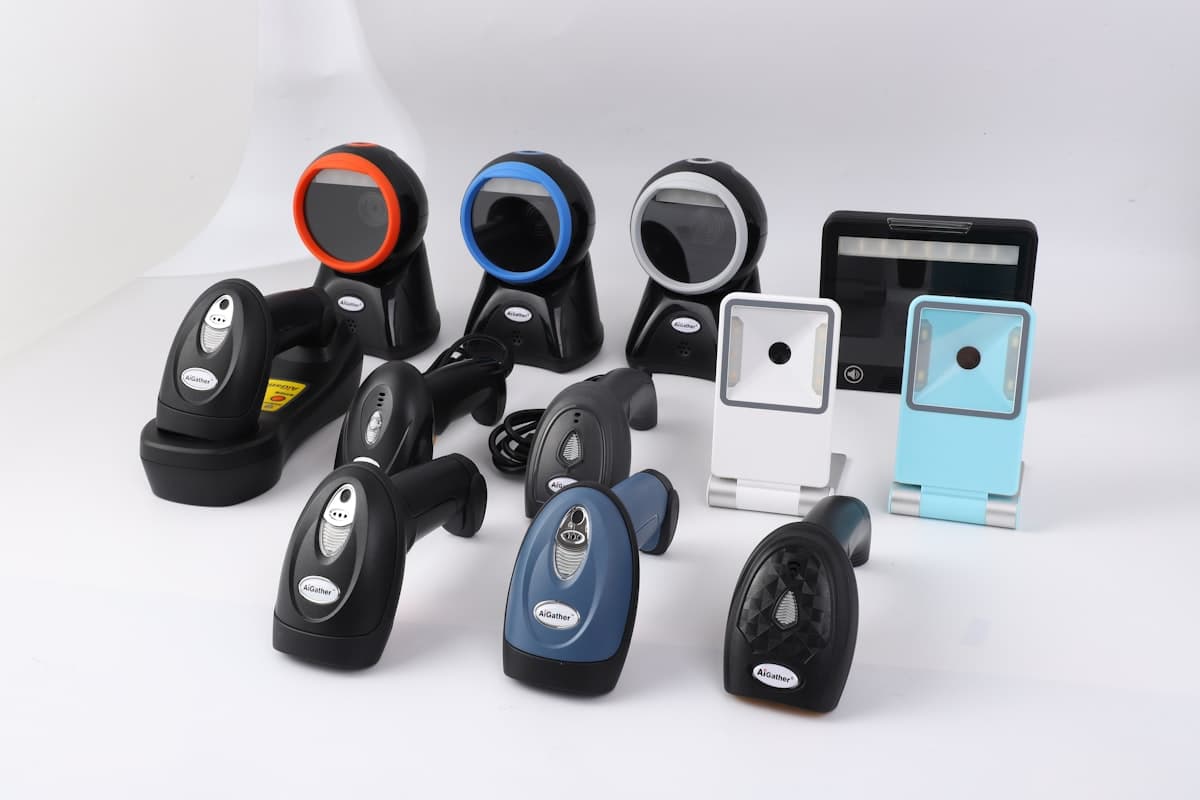
Calnedra ScanLink Inventory Reader

Calnedra ScanLink Inventory Reader

A cordless Bluetooth 2D reader for serial numbers, UDI labels and HCPCS bin tags in the stockroom and on the van. Every scan syncs to your Predictive Replenishment Planning dashboard as a live stock and transfer movement.

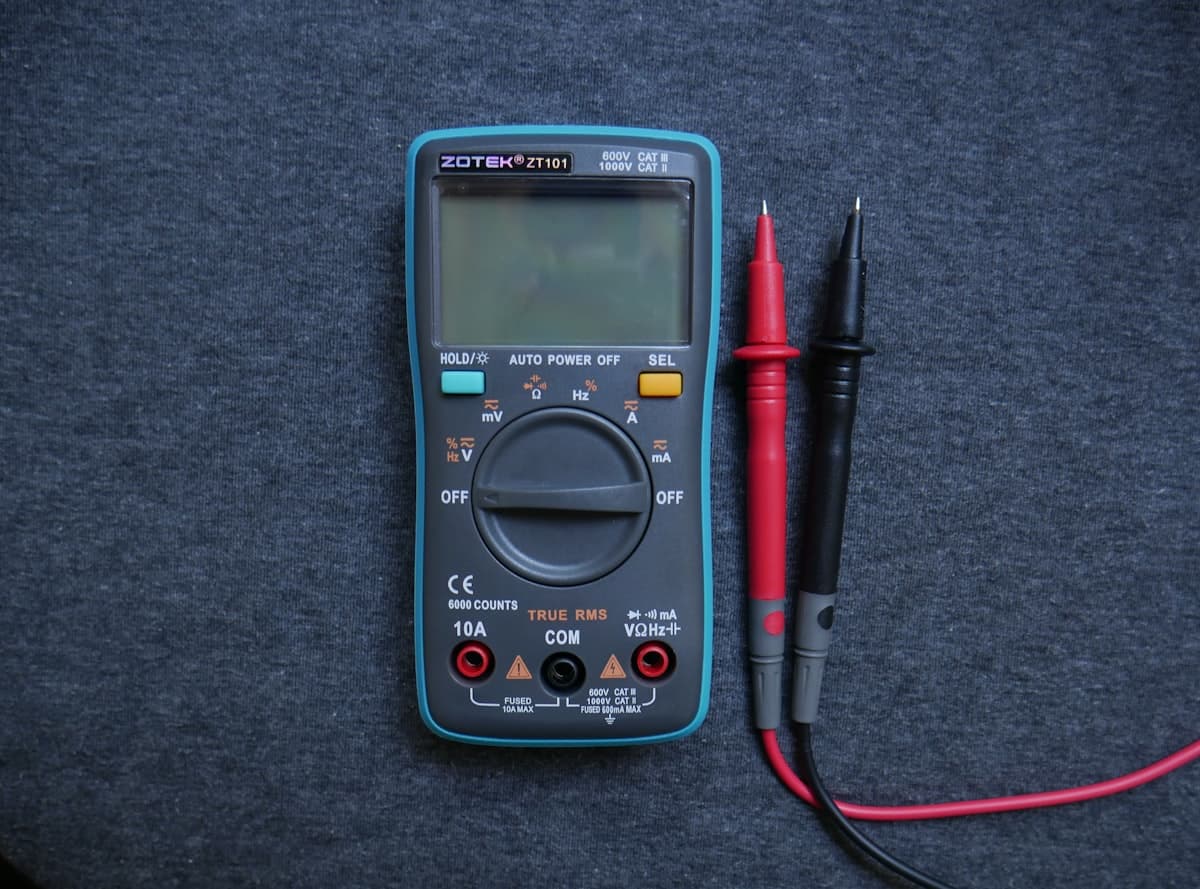
Calnedra AssetPulse Battery Monitor

Calnedra AssetPulse Battery Monitor

A wireless clip-on tag that watches power-wheelchair and hospital-bed battery packs on rented assets in the field. It streams voltage, runtime and charge-cycle telemetry to your Maintenance Scheduling dashboard, so a failing pack is flagged and replaced before it strands a patient.

Shown to illustrate the connected companion devices that pair with Calnedra.AI — info only, nothing here is sold through us.

Pricing

Simple, transparent pricing

One flat monthly price for the whole platform. No per-seat maths, no tiers to decode, nothing switched off behind a plan name.

Flat monthly · every module included

Full platform

Everything Calnedra.AI does, for your whole DME operation — every branch, every equipment class, every payer.

Starting at
$200/mo
  • Inventory Demand Forecasting
  • Equipment Quoting Assistant
  • Predictive Replenishment Planning
  • Billing Anomaly Detection
  • Document Intelligence
  • Maintenance Scheduling
Know more

Talk to us and we’ll tailor the rollout to your branches.

Onboarding

What your onboarding fee covers

A one-time setup that gets Calnedra.AI running against your real fleet before the first monthly cycle — we import your equipment catalogue, HCPCS families and payer rules, connect your billing and inventory systems, and tune every module to how your branches buy, quote and service. Each fee below is a starting point: we scope the final onboarding once we understand your environment, security and compliance needs, integrations, data volume and deployment model.

Two ways to run Calnedra.AI

Same platform, same monthly subscription either way — only where it runs changes.

Cloud (SaaS)

Runs in Nestack’s managed cloud — the fastest way to go live, with hosting, updates and forecasting infrastructure handled for you. No servers to stand up before your first replenishment cycle.

Private / self-hosted

The same platform deployed inside your own infrastructure — your cloud, VPC or on-prem — for teams handling protected health information, claims and demand predictions. Patient and billing data never leaves your environment, and the monthly subscription stays the same.

Essential

$1,000+one-time
  • Kickoff call and go-live plan scoped to your branches and equipment classes
  • Calnedra workspace provisioning with admin and buyer accounts
  • Import of your active equipment catalogue and HCPCS families
  • Inventory Demand Forecasting tuned to your stock levels and stockout thresholds
  • Payer fee schedules and allowed-amount rules loaded for billing checks
  • Roles and branch permissions set for your first users
  • Live-readiness check across forecasting, quoting and billing before your first cycle
  • Onboarding handbook and self-serve help for buyers and billers

Plus

Most teams
$2,500+one-time

Everything in Essential, plus:

  • Guided migration of historical rentals, service records and claims, with validation
  • Two integrations with your DME billing, EHR or inventory systems
  • Custom quote templates, replenishment rules and maintenance schedules configured
  • Live training for buyers, billers and service techs, with a recording
  • Dedicated onboarding specialist through your first replenishment and billing cycle

Enterprise

$5,000+one-time

Everything in Plus, plus:

  • Multi-branch rollout plan across every warehouse, payer and equipment line
  • Bespoke payer and clearinghouse integrations with API / SSO configuration
  • Bulk migration of legacy inventory and claims with cleansing and reconciliation
  • Role-based training tracks for operations, billing and field-service teams
  • Named onboarding manager with a defined go-live date and post-launch tuning
Common questions

Your questions, answered

The things DME providers ask us before they get started.

1.Will it work with the billing and inventory systems we already run?

Calnedra.AI connects read-only to your existing inventory, rental, billing and service systems and works from the data that is already there. There is no migration and nothing to rip out — most providers are live within a day, and your team keeps working in the tools they know.

2.How is patient health information handled?

Everything is built around the HIPAA Privacy and Security Rules: records are encrypted, access is controlled per role, and every read and write is audited. The platform only needs the fields it uses — order, code, device and claim data — and it never exposes PHI in a forecast or a quote.

3.How long does onboarding actually take?

Connecting the data is usually a day. The forecasting models need a couple of cycles of your own history before their confidence scores settle, so most branches judge the numbers at the four-week mark rather than on day one.

4.Does it handle rentals as well as outright sales?

Rentals are the harder half, so they are the half we built for first. Planning tracks the rental-ready reserve behind each equipment class, watches for rental overlap on the billing side, and keeps due-back units in the replenishment picture rather than treating them as gone.

5.What happens when a claim gets flagged?

It lands in a triaged review queue with the reason attached — modifier mismatch, rental overlap, authorisation gap, unit outlier — along with the at-risk amount and the model's confidence. Your billing team decides; nothing is submitted or written off automatically.

6.Do we have to change how we code?

No. The platform works natively in HCPCS Level II codes and the DMEPOS modifiers you already use, so forecasts, quotes and flags come back in the same language your team writes in.

Book a demo

See Calnedra.AI on your own numbers.

Tell us who you are, pick what you want to see, then grab a time. Forty-five minutes, no slide deck.

Step 1 of 3

First, who should we prepare for?

A few seconds — so we come ready for your team.