One connected record for every job, decision, and release.
WrenchOrbit AI connects verified intake, technician-led diagnostics, customer authorization, fitment-aware parts, bay execution, QC/PDI, warranty recovery, invoicing and delivery. AI organizes evidence, detects missing or conflicting records, and drafts the next step; accountable people approve technical, commercial and release decisions.
One operational view across every repair and delivery exception.
Your shop runs on information that currently lives in many different places. Nine connected modules bring it into one AI layer — from dashboard oversight and verified intake through diagnostics, estimates, parts, repairs, QC/PDI, warranty and final delivery. No silos. No re-entry.
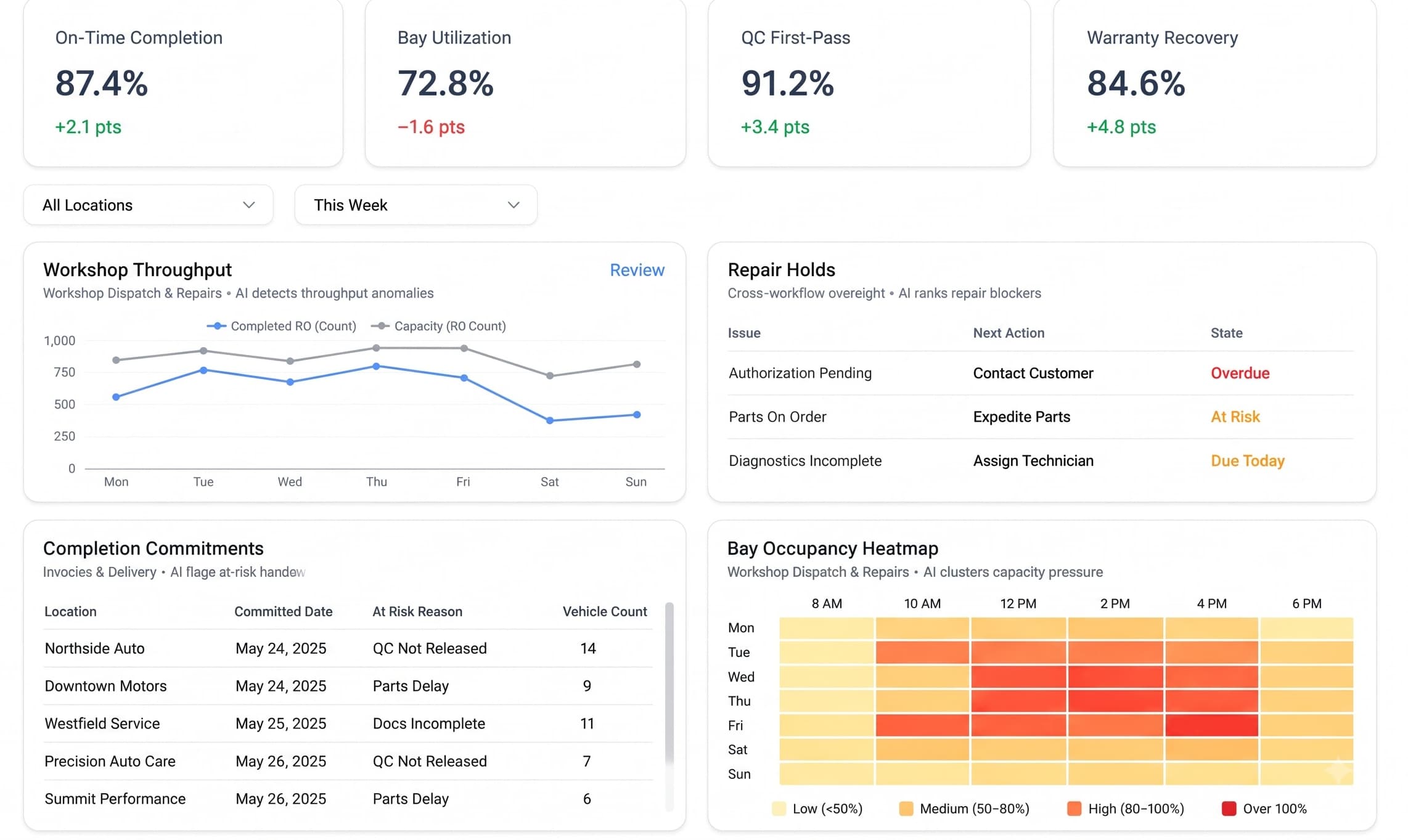
app.wrenchorbit.ai/dashboardLIVE · OPERATIONS
WrenchOrbit AI — workshop operations dashboard
Tap a number to explore the dashboard
Intake Target
−40%
Intake administration time
Target reduction versus your measured baseline when VIN/HIN data, complaints, condition, custody and authorization are captured once and reused across the repair order.
Approval Target
−30%
Estimate-to-approval cycle
Target reduction from drafting itemized estimates, detecting missing operations and preserving approval evidence without rebuilding the repair scope by hand.
Readiness Target
−25%
Parts and bay waiting time
Target reduction when fitment, supply constraints, technician capability, bay availability and stop-work reasons are visible before and during execution.
Warranty Target
−35%
Claim preparation time
Target reduction from assembling complaint-cause-correction, labor, parts, failed-component, QC/PDI and submission evidence from the linked repair record.
How targets are measured: Percentages are configurable implementation targets, calculated against each customer’s pre-launch baseline; they are not universal guaranteed outcomes. Diagnostic and sensor evidence is imported only through supported equipment, files or authorized integrations, with manual evidence entry available.
Modules
One command center with eight accountable specialist modules.
One Dashboard at the centre. Eight purpose-built modules around it: intake, diagnostics, estimates, parts, dispatch, QC/PDI, warranty, and invoices/delivery. One subscription. Zero silos.
01Vehicle Intake
02Vehicle Diagnostics
03Repair Estimates & Approvals
04Parts Fulfillment
05Workshop Dispatch & Repairs
06Repair QC & PDI
07Warranty Claims
08Invoices & Delivery
One platform
One record. Every decision. No broken handoff.
The unit, repair order, evidence, approvals, parts, labor, inspection, claim and closeout remain connected from intake to delivery.
Operational workflows, built in.
From verified intake through technical release, every operational record stays linked to the same repair or preparation order.
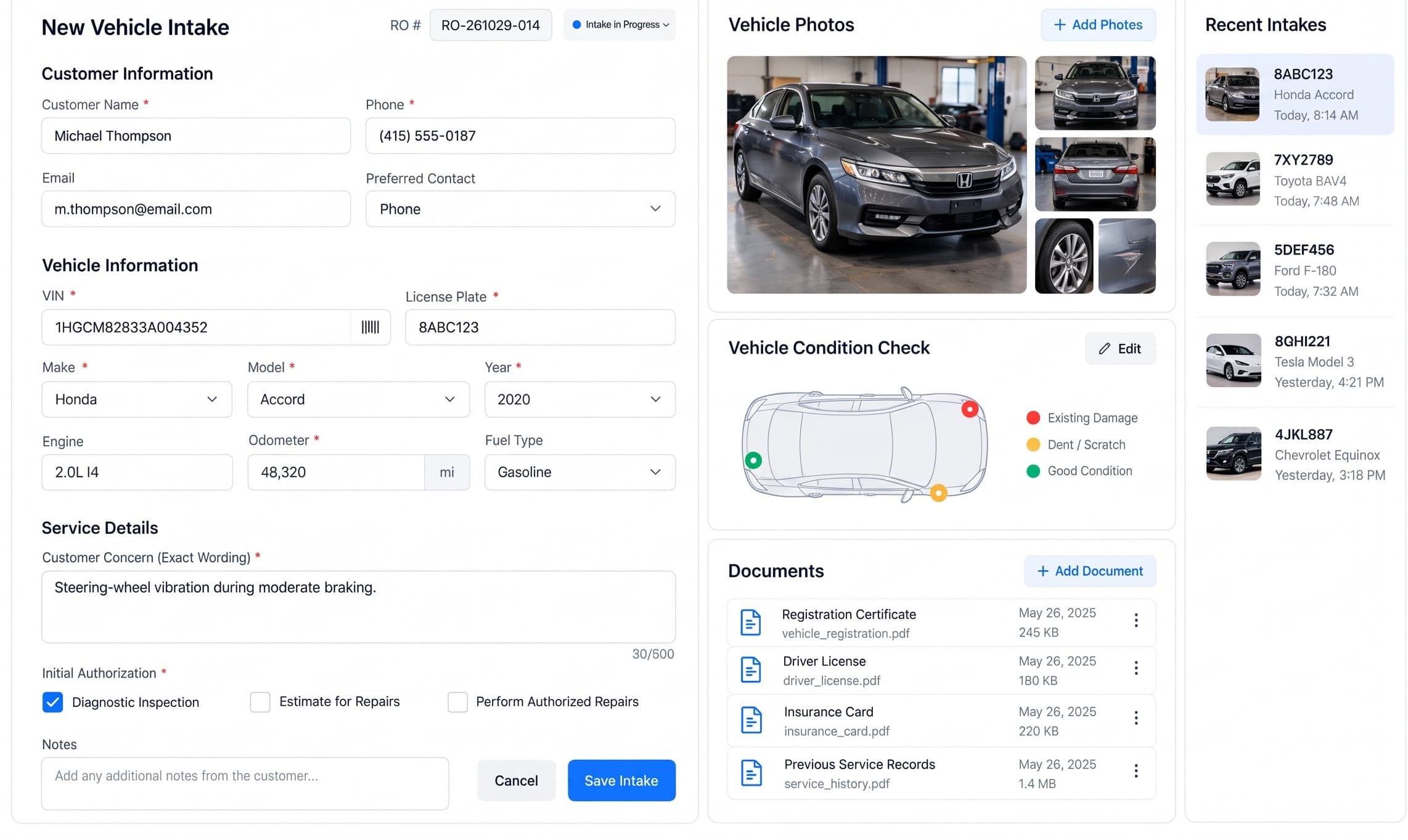
app.wrenchorbit.ai/intakeLIVE · INTAKE
Vehicle Intake — WrenchOrbit AI
Vehicle Intake
Capability: captures VIN/HIN or unit identity, complaints, condition, custody, ownership, service history and authorization. AI extracts documents, structures complaints and flags identity or consent gaps; automation creates the initial repair or preparation order only when required intake evidence is present.
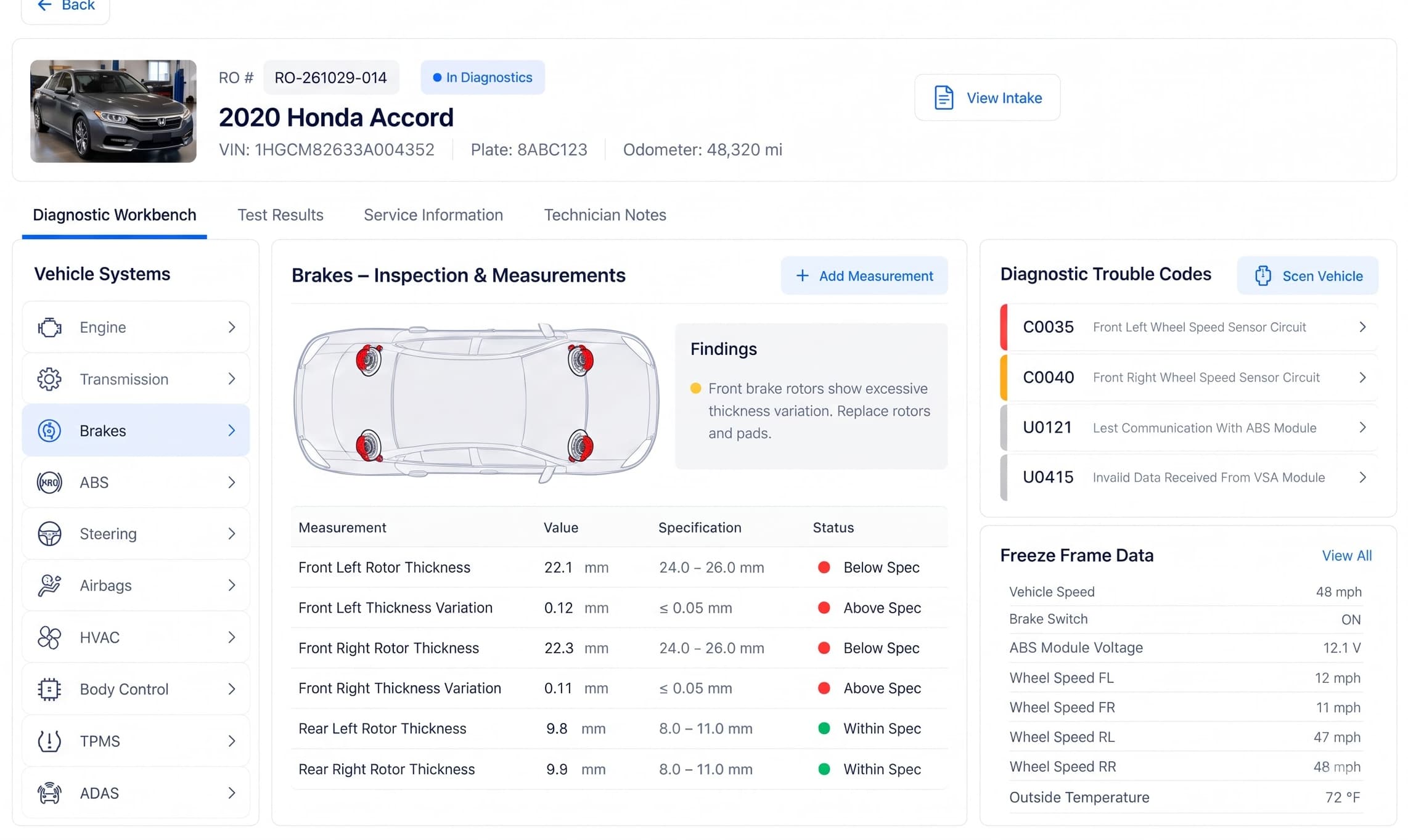
app.wrenchorbit.ai/diagnosticsLIVE · DIAGNOSTICS
Vehicle Diagnostics — WrenchOrbit AI
Vehicle Diagnostics
Capability: records technician-led tests, DTCs, freeze-frame data, measurements, OEM references and confirmed findings. AI organizes reports, compares applicable specifications and detects missing tests; automation links reviewed recommendations to estimating without inventing pass/fail evidence.
app.wrenchorbit.ai/intakeLIVE · INTAKE
Vehicle Intake dashboard
Vehicle Intake
Capability: captures VIN/HIN or unit identity, complaints, condition, custody, ownership, service history and authorization. AI extracts documents, structures complaints and flags identity or consent gaps; automation creates the initial repair or preparation order only when required intake evidence is present.
app.wrenchorbit.ai/diagnosticsLIVE · DIAGNOSTICS
Vehicle Diagnostics dashboard
Vehicle Diagnostics
Capability: records technician-led tests, DTCs, freeze-frame data, measurements, OEM references and confirmed findings. AI organizes reports, compares applicable specifications and detects missing tests; automation links reviewed recommendations to estimating without inventing pass/fail evidence.
app.wrenchorbit.ai/quotesLIVE · ESTIMATES
Repair Estimates & Approvals dashboard
Repair Estimates & Approvals
Approved repair scope, preserved through every revision.
Capability: converts verified findings into versioned labor, parts, fees, taxes, supplements and customer approvals while preserving declined work and authorization history. AI drafts estimates, compares revisions and detects missing, duplicated or unauthorized operations. Automation releases only approved parts and labor scope to the next workflow stage.
app.wrenchorbit.ai/inventoryLIVE · PARTS
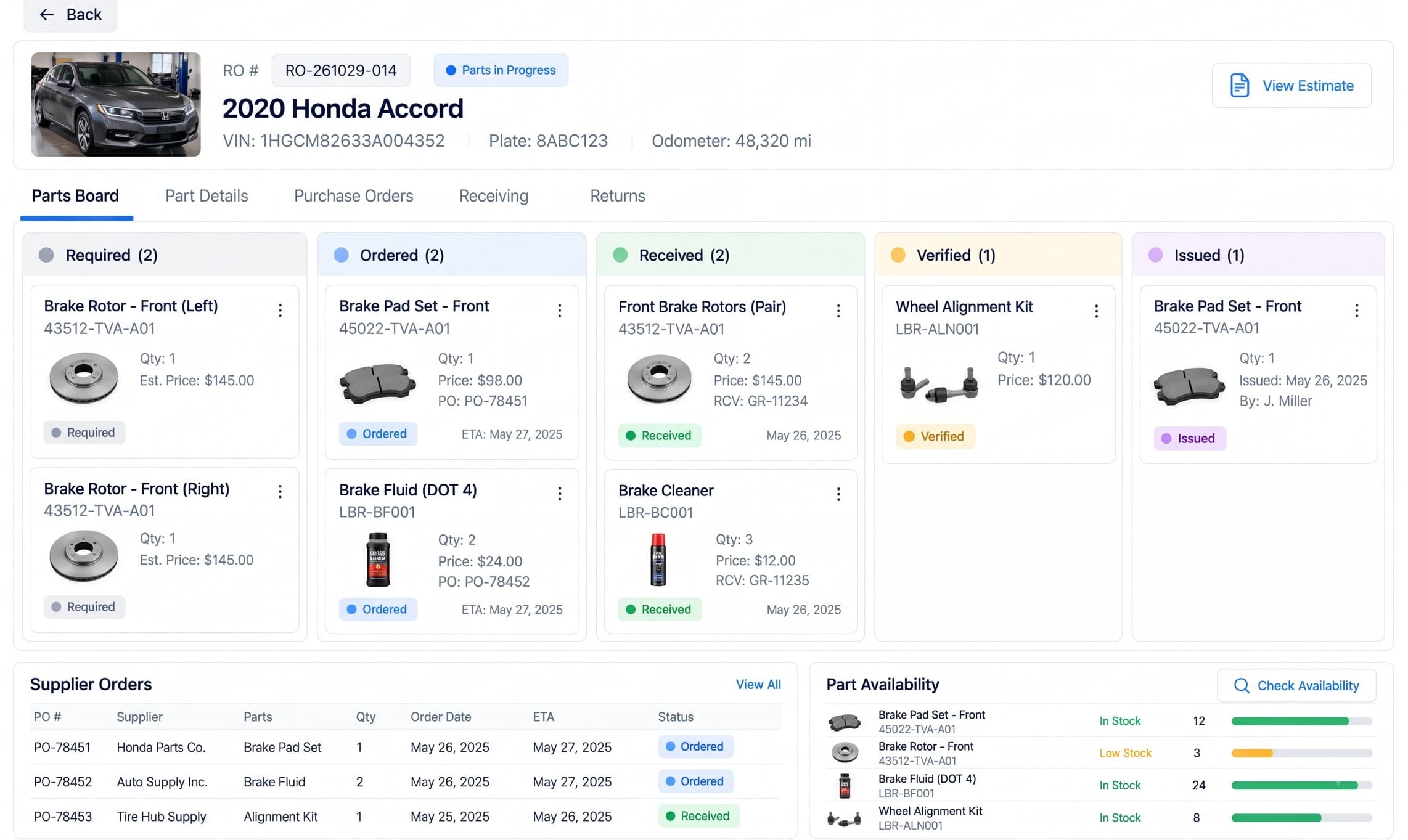
Parts Fulfillment dashboard
Parts Fulfillment
Fitment verified, procured, received, and ready for the bay.
Capability: verifies OEM or approved aftermarket fitment and tracks purchase orders, receiving, allocation, issue, returns, cores and failed components against authorized work. AI assists applicability, supersession and discrepancy review. Automation updates repair readiness and creates explicit blockers for unverified fitment, shortages or backorders.
app.wrenchorbit.ai/dispatchLIVE · DISPATCH
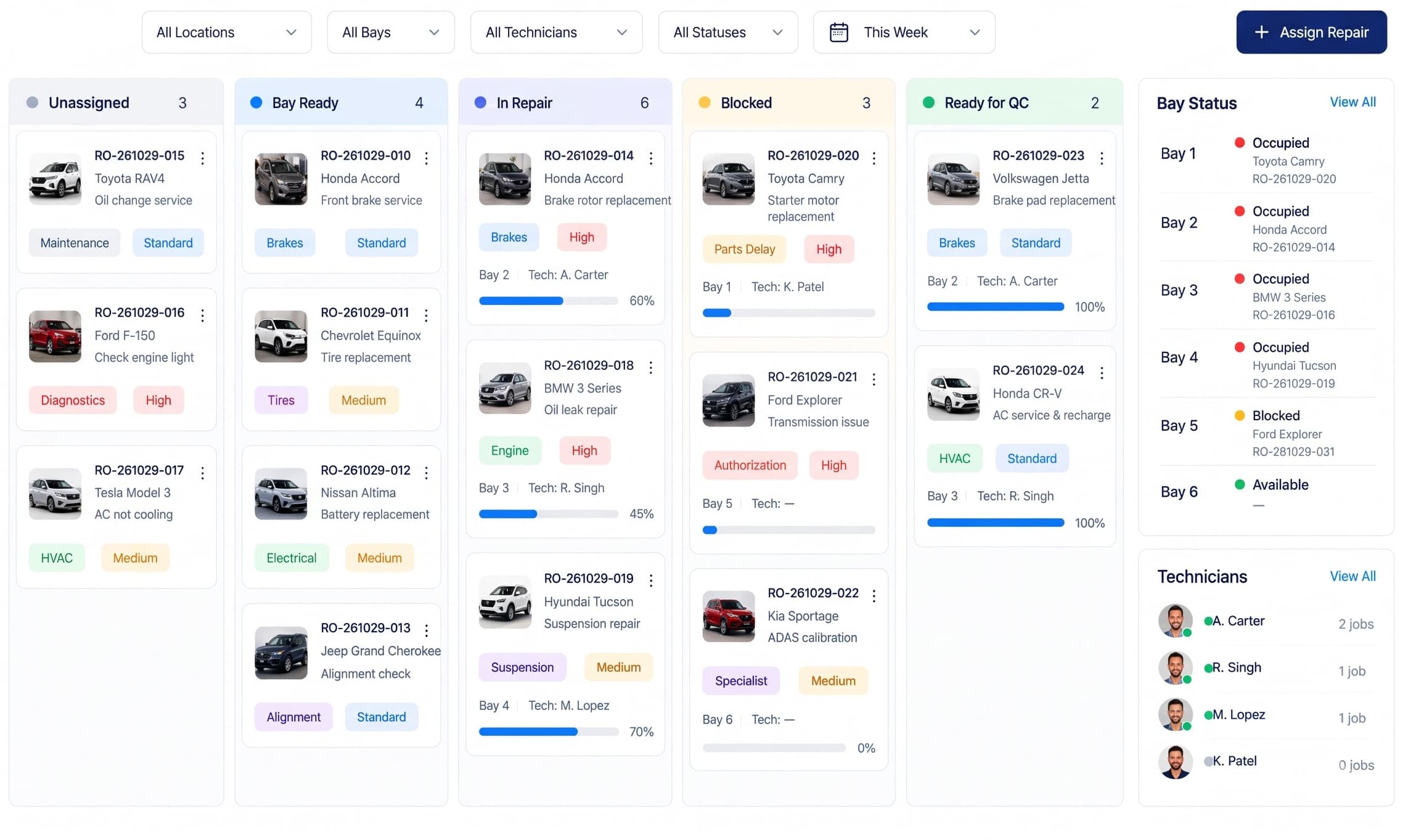
Workshop Dispatch & Repairs dashboard
Workshop Dispatch & Repairs
Approved work assigned to the right bay and technician.
Capability: assigns qualified technicians and bays, records labor and installed parts, tracks active or blocked operations and controls stop-work escalation. AI recommends technician and bay allocation and identifies missing prerequisites or repair evidence. Automation prevents unapproved scope expansion and routes completed work to inspection.
app.wrenchorbit.ai/qcLIVE · QC / PDI
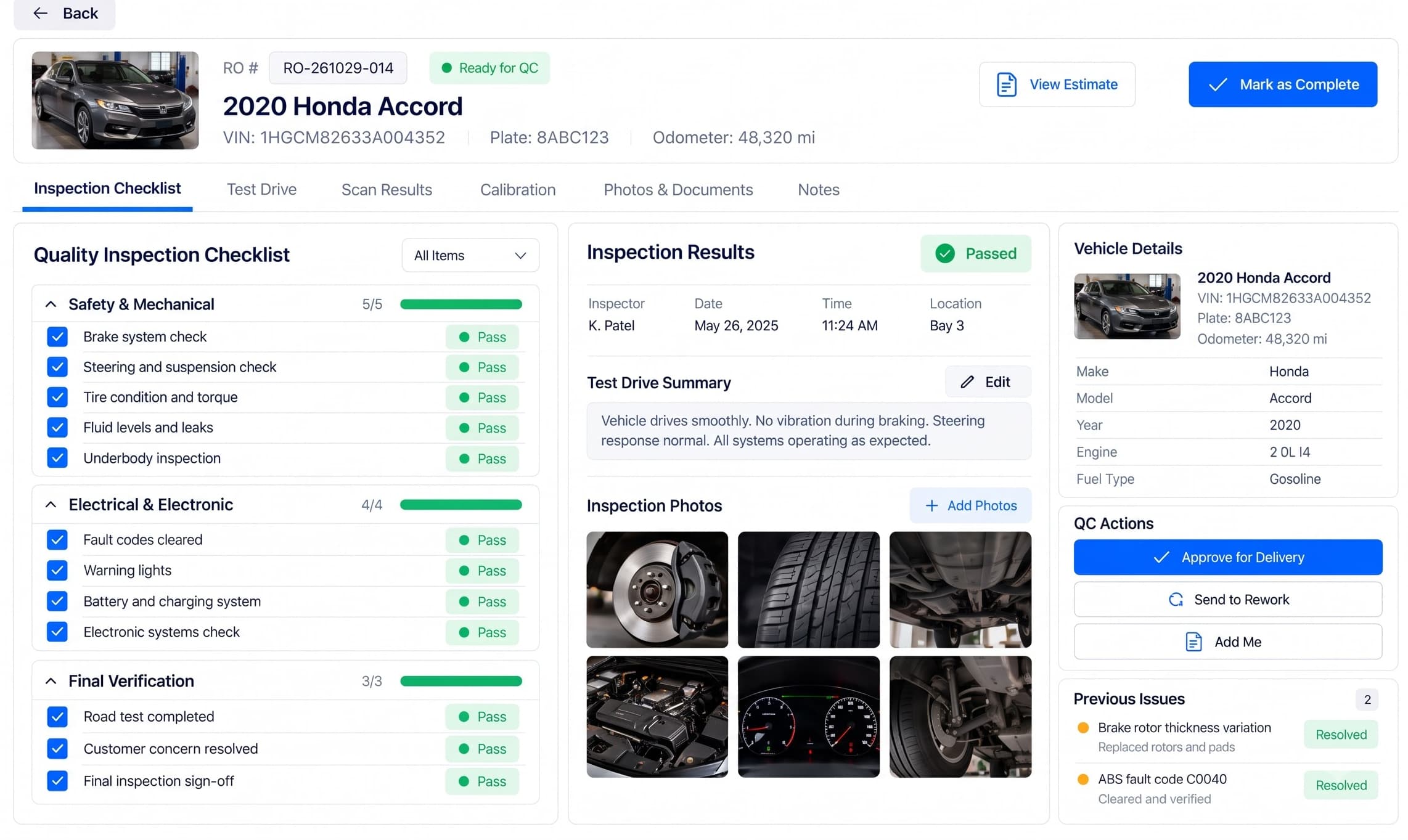
Repair QC & PDI dashboard
Repair QC & PDI
Repairs and new units released with accountable evidence.
Capability: runs repair QC or vehicle-class-specific PDI using checklists, measurements, road tests, calibration evidence, recall restrictions and inspector sign-off. AI detects missing measurements, signatures and evidence discrepancies. Automation returns failed inspections to rework and withholds release until accountable approval.
app.wrenchorbit.ai/warrantyLIVE · WARRANTY
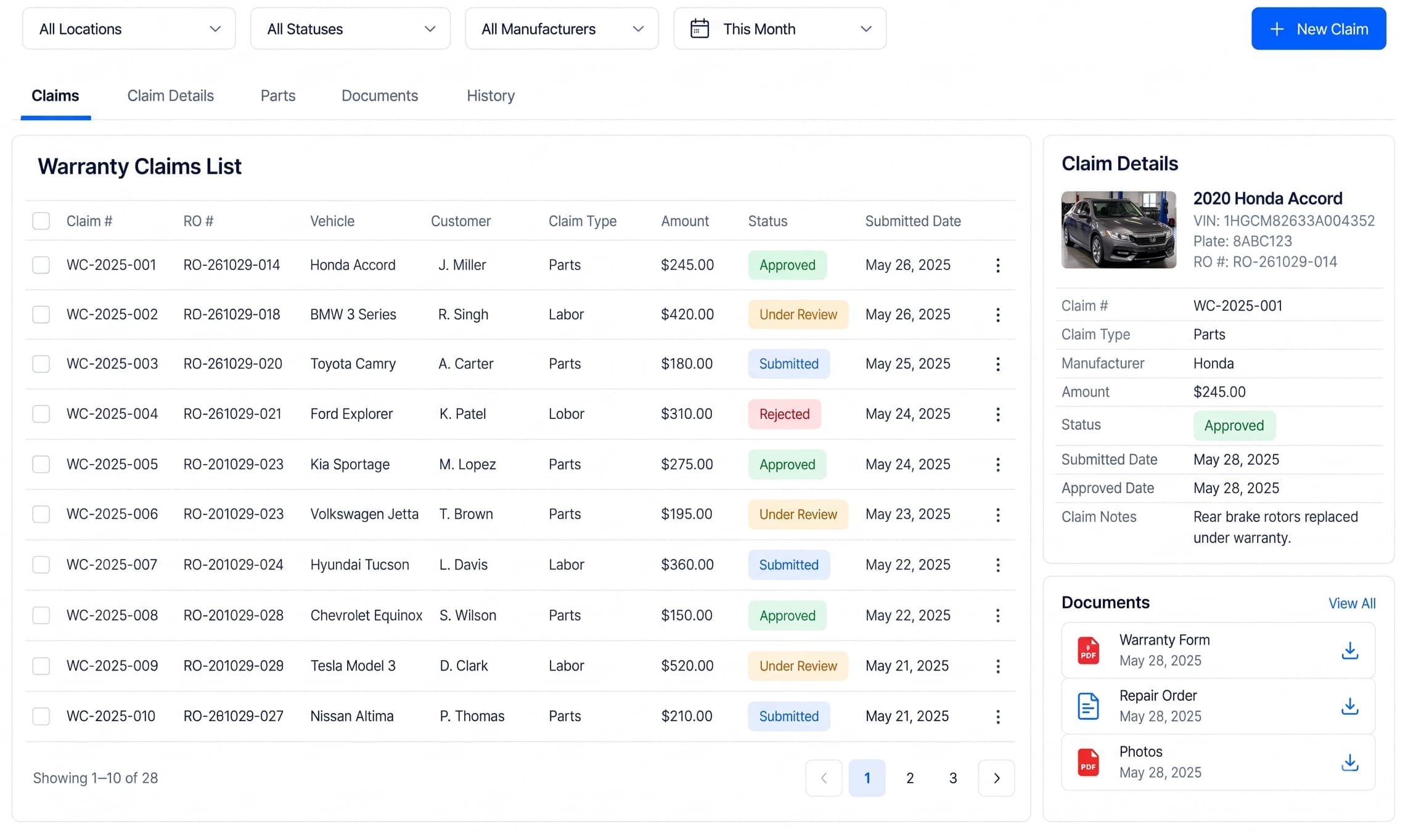
Warranty Claims dashboard
Warranty Claims
Capability: manages eligibility, complaint-cause-correction, labor and part codes, failed-part disposition, submission, adjudication and reimbursement. AI drafts narratives and detects missing or duplicate claim evidence; automation routes corrections and reconciles accepted payment to the repair order.
app.wrenchorbit.ai/invoicesLIVE · CLOSEOUT
Invoices & Delivery dashboard
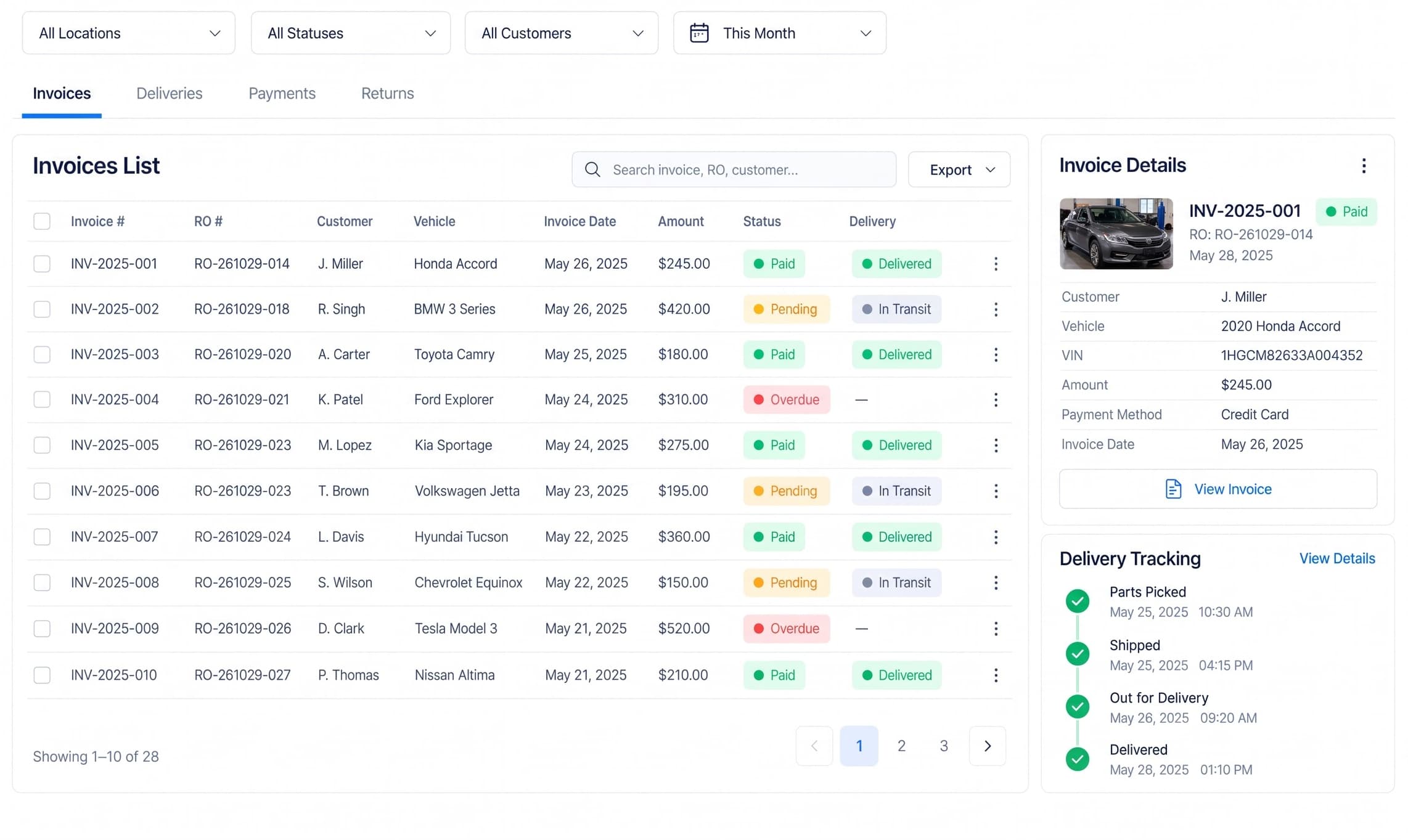
Invoices & Delivery
Capability: reconciles approved work, labor, parts, warranty, taxes, payments, financing, title/registration and delivery evidence. AI detects unapproved charges and document inconsistencies; automation blocks finalization or release when QC, recall, payment or delivery requirements remain unresolved.
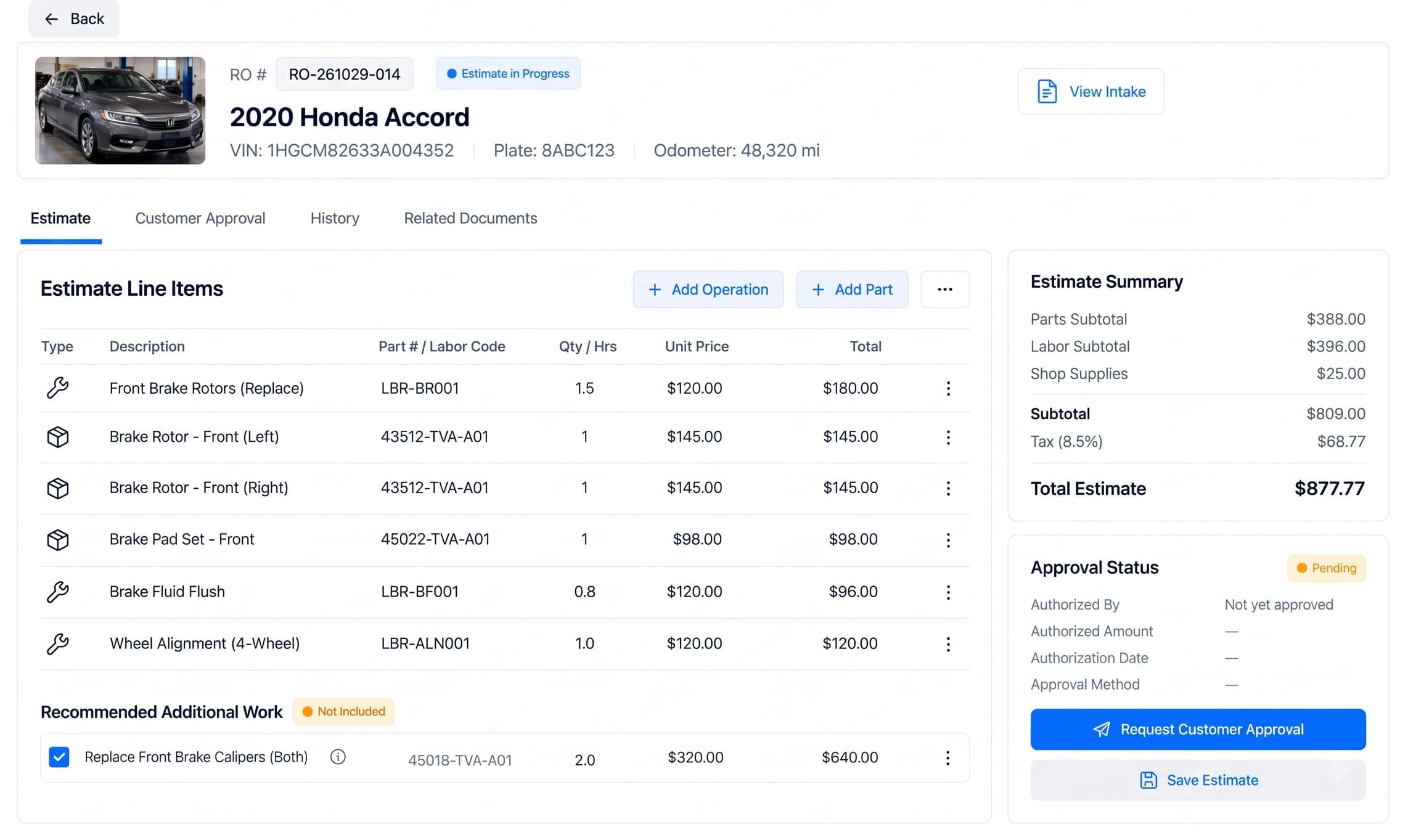
app.wrenchorbit.ai/quotesLIVE · ESTIMATES
Repair Estimates & Approvals — WrenchOrbit AI
Repair Estimates & Approvals
Approved repair scope, preserved through every revision.
Capability: converts verified findings into versioned labor, parts, fees, taxes, supplements and customer approvals while preserving declined work and authorization history.
AI drafts estimates, compares revisions and detects missing, duplicated or unauthorized operations. Automation releases only approved parts and labor scope to the next workflow stage.
app.wrenchorbit.ai/inventoryLIVE · PARTS
Parts Fulfillment — WrenchOrbit AI
Parts Fulfillment
Fitment verified, procured, received, and ready for the bay.
Capability: verifies OEM or approved aftermarket fitment and tracks purchase orders, receiving, allocation, issue, returns, cores and failed components against authorized work.
AI assists applicability, supersession and discrepancy review. Automation updates repair readiness and creates explicit blockers for unverified fitment, shortages or backorders.
app.wrenchorbit.ai/dispatchLIVE · DISPATCH
Workshop Dispatch & Repairs — WrenchOrbit AI
Workshop Dispatch & Repairs
Approved work assigned to the right bay and technician.
Capability: assigns qualified technicians and bays, records labor and installed parts, tracks active or blocked operations and controls stop-work escalation.
AI recommends technician and bay allocation and identifies missing prerequisites or repair evidence. Automation prevents unapproved scope expansion and routes completed work to inspection.
app.wrenchorbit.ai/qcLIVE · QC / PDI
Repair QC & PDI — WrenchOrbit AI
Repair QC & PDI
Repairs and new units released with accountable evidence.
Capability: runs repair QC or vehicle-class-specific PDI using checklists, measurements, road tests, calibration evidence, recall restrictions and inspector sign-off.
AI detects missing measurements, signatures and evidence discrepancies. Automation returns failed inspections to rework and withholds release until accountable approval.
Warranty recovery and closeout, side by side.
Warranty evidence, reimbursement, approved charges, payment and delivery release run from the same repair-order record.
app.wrenchorbit.ai/warrantyLIVE · WARRANTY
Warranty Claims — WrenchOrbit AI
Warranty Claims
Capability: manages eligibility, complaint-cause-correction, labor and part codes, failed-part disposition, submission, adjudication and reimbursement. AI drafts narratives and detects missing or duplicate claim evidence; automation routes corrections and reconciles accepted payment to the repair order.
app.wrenchorbit.ai/invoicesLIVE · CLOSEOUT
Invoices & Delivery — WrenchOrbit AI
Invoices & Delivery
Capability: reconciles approved work, labor, parts, warranty, taxes, payments, financing, title/registration and delivery evidence. AI detects unapproved charges and document inconsistencies; automation blocks finalization or release when QC, recall, payment or delivery requirements remain unresolved.
How it works
From verified intake to accountable release — three operational stages.
WrenchOrbit AI connects the nine-module workflow on one AI layer: intake, diagnostics, estimates, parts, dispatch, QC/PDI, warranty and invoices/delivery around a shared Dashboard. Your team makes the accountable decisions; the platform keeps the evidence moving.
Intake & Diagnostics
01→
Unit in, evidence ready
Vehicle Intake captures VIN/HIN or applicable unit identity, complaints, condition, custody and authorization in one verified record. Vehicle Diagnostics then organizes DTCs, measurements and technician findings before repair recommendations are made.
VIN/HIN, complaint, condition and authorization checks in one intake
DTCs, measurements and OEM specifications organized for review
Missing evidence and identity discrepancies surfaced before work begins
Estimate, Parts & Repair
02→
Approved, ready, and on the board
Repair Estimates & Approvals converts confirmed findings into priced labor, parts, fees, taxes and customer authorization while preserving every revision and declined operation.
Itemized estimate with approval identity, time, method and scope
Parts matched against unit configuration, stock and supplier lead time
Labor, installed parts, blockers and completion evidence stay linked
QC, Warranty & Delivery
03
Released with the evidence attached
Repair QC & PDI verifies completed work against applicable procedures, measurements, functional tests, calibration evidence and recall restrictions before release.
QC/PDI holds unresolved defects until authorized inspection sign-off
Warranty complaint-cause-correction evidence linked to the repair order
Invoice, payment, release restrictions and delivery acknowledgment reconciled
Evidence
Every recommendation stays linked to source records
Control
Authorization and scope changes remain auditable
Readiness
Parts, bays and technicians align before work starts
Accountability
QC, warranty, payment and delivery close together
Manual administration vs WrenchOrbit AI
AI assists the record. People own the decision.
The useful boundary is not which model runs a task. It is whether the recommendation is source-linked, reviewable and prevented from bypassing authorization, technical or release controls.
Workflow decision
Disconnected process
Source-linked AI
01
Extract intake documents and compare unit identity
The assistant structures complaints, condition, custody and authorization while conflicting VIN/HIN or ownership evidence creates a review hold.
Manual search and re-entry
Evidence extraction
SOURCE-LINKED · REVIEWABLE
02
Organize technician tests and diagnostic findings
DTCs, measurements, freeze-frame data and OEM references are grouped without converting an absent specification into a fabricated pass or fail.
Manual search and re-entry
Diagnostic assistance
TECHNICIAN DECISION REQUIRED
03
Draft and compare repair-scope versions
AI can propose labor, parts and explanations, while approval identity, method, timestamp, declined work and every revision remain preserved.
Manual search and re-entry
Estimate assistance
AUTHORIZATION GATE
04
Check fitment and operational readiness
Applicability, supersession, parts availability, technician qualification and bay capability are compared before work is released.
Manual search and re-entry
Readiness analysis
BLOCKERS STAY VISIBLE
05
Detect missing QC, claim and delivery evidence
Measurements, signatures, complaint-cause-correction, approved charges, recall holds and handover records are checked before closeout.
Manual search and re-entry
Evidence controls
RELEASE CANNOT BE ASSUMED
06
Record the source, reviewer and resulting action
Recommendations remain explainable and reviewable, and approvals, overrides, corrections and releases create timestamped audit events.
Manual search and re-entry
Accountable AI
SOURCE · REVIEW · AUDIT
Result
Re-entry, hidden gaps, weak traceability
Source visible · Human review retained · Audit event recorded
01
Extract intake documents and compare unit identity
The assistant structures complaints, condition, custody and authorization while conflicting VIN/HIN or ownership evidence creates a review hold.
Disconnected process
Manual search and re-entry
Source-linked AI
Evidence extraction
SOURCE-LINKED · REVIEWABLE
02
Organize technician tests and diagnostic findings
DTCs, measurements, freeze-frame data and OEM references are grouped without converting an absent specification into a fabricated pass or fail.
Disconnected process
Manual search and re-entry
Source-linked AI
Diagnostic assistance
TECHNICIAN DECISION REQUIRED
03
Draft and compare repair-scope versions
AI can propose labor, parts and explanations, while approval identity, method, timestamp, declined work and every revision remain preserved.
Disconnected process
Manual search and re-entry
Source-linked AI
Estimate assistance
AUTHORIZATION GATE
04
Check fitment and operational readiness
Applicability, supersession, parts availability, technician qualification and bay capability are compared before work is released.
Disconnected process
Manual search and re-entry
Source-linked AI
Readiness analysis
BLOCKERS STAY VISIBLE
05
Detect missing QC, claim and delivery evidence
Measurements, signatures, complaint-cause-correction, approved charges, recall holds and handover records are checked before closeout.
Disconnected process
Manual search and re-entry
Source-linked AI
Evidence controls
RELEASE CANNOT BE ASSUMED
06
Record the source, reviewer and resulting action
Recommendations remain explainable and reviewable, and approvals, overrides, corrections and releases create timestamped audit events.
Disconnected process
Manual search and re-entry
Source-linked AI
Accountable AI
SOURCE · REVIEW · AUDIT
Result
Source visible · Human review retained · Audit event recorded
Note: AI assists extraction, comparison, drafting and exception detection. It does not replace technician diagnosis, customer authorization, inspection sign-off, warranty adjudication or release authority. Availability depends on configured data sources and implementation scope.
Compliance
Compliance evidence follows the work.
WrenchOrbit AI keeps authorization, technical evidence, role accountability and release restrictions on the same operational record instead of rebuilding the trail after an exception.
Note: These are workflow controls are configured to the actual OEM program, jurisdiction, vehicle class and shop activity. They are not a certification claim and do not replace legal, regulatory or technical review.
AUTH
Authorization and scope control
Approval identity, time, method and exact scope are preserved with every estimate version. Unapproved labor, parts and invoice lines are held instead of silently entering execution or closeout.
QC / PDI
Technical release evidence
Applicable inspections, measurements, road tests, calibration evidence, recall restrictions and accountable sign-off remain attached to the repair or preparation order before release.
AUDIT
Role-based accountability
Approvals, overrides, scope changes, failed inspections, claim corrections, invoice exceptions and delivery release create timestamped events tied to the responsible role.
RULES
Jurisdiction and activity controls
Required records and release gates are configured for the actual vehicle class, OEM program, jurisdiction and shop activity instead of assuming one universal compliance rule set.
AUTHAuthorization and scope control
Approval identity, time, method and exact scope are preserved with every estimate version. Unapproved labor, parts and invoice lines are held instead of silently entering execution or closeout.
QC / PDITechnical release evidence
Applicable inspections, measurements, road tests, calibration evidence, recall restrictions and accountable sign-off remain attached to the repair or preparation order before release.
AUDITRole-based accountability
Approvals, overrides, scope changes, failed inspections, claim corrections, invoice exceptions and delivery release create timestamped events tied to the responsible role.
RULESJurisdiction and activity controls
Required records and release gates are configured for the actual vehicle class, OEM program, jurisdiction and shop activity instead of assuming one universal compliance rule set.
Add-ons
Add the hardware your workflow needs.
Most evidence starts on a vehicle, tool or shop-floor document. These standard third-party peripherals can be enrolled against your WrenchOrbit AI workspace so their output reaches the module that already owns the record.
01 · Feeds Vehicle Intake
High-speed VIN & document scanner
Capture registrations, insurance cards and repair orders, then extract vehicle identity and customer authorization into the intake record without manual keying.
02 · Feeds Vehicle Diagnostics
Wireless OBD-II / CAN interface
Stream supported trouble codes, freeze-frame values and live PID readings into the diagnostic workbench while keeping technician interpretation reviewable.
03 · Feeds Workshop Dispatch & Repairs
Rugged workshop technician tablet
Let technicians receive assignments, log labor, record hold reasons, verify parts and upload repair evidence directly from the bay.
04 · Feeds Repair QC & PDI
Wireless tread & brake gauge
Send tread-depth, pad and rotor measurements into QC/PDI so measured inspection evidence stays attached to the repair order and release decision.
Note: Hardware, installation and integration are not included in the standard subscription. Additional charges depend on the hardware selected, integration modules required and implementation scope.
Connectivity
Connect evidence without inventing availability.
Exchange identity, technical, parts, authorization, warranty and financial records with supported systems. Every connection is scoped by provider, region and implementation; controlled manual entry remains available when an API or live source is not.
VIN / HIN verificationIdentityOEM service informationTechnical evidenceDiagnostic equipmentTechnical evidenceInspection evidenceTechnical evidenceParts distributorsFulfillmentLabor and estimating dataEstimatingWorkshop schedulingExecutionCustomer communicationsAuthorizationVIN / HIN verificationIdentityOEM service informationTechnical evidenceDiagnostic equipmentTechnical evidenceInspection evidenceTechnical evidenceParts distributorsFulfillmentLabor and estimating dataEstimatingWorkshop schedulingExecutionCustomer communicationsAuthorizationVIN / HIN verificationIdentityOEM service informationTechnical evidenceDiagnostic equipmentTechnical evidenceInspection evidenceTechnical evidenceParts distributorsFulfillmentLabor and estimating dataEstimatingWorkshop schedulingExecutionCustomer communicationsAuthorization
Warranty portalsRecoveryAccounting systemsCloseoutPayment processorsCloseoutDocument storageEvidenceCustomer authorization recordsApprovalRecall and campaign dataReleaseTitle and registration recordsDeliveryEnvironmental recordsComplianceWarranty portalsRecoveryAccounting systemsCloseoutPayment processorsCloseoutDocument storageEvidenceCustomer authorization recordsApprovalRecall and campaign dataReleaseTitle and registration recordsDeliveryEnvironmental recordsComplianceWarranty portalsRecoveryAccounting systemsCloseoutPayment processorsCloseoutDocument storageEvidenceCustomer authorization recordsApprovalRecall and campaign dataReleaseTitle and registration recordsDeliveryEnvironmental recordsCompliance
Note: Provider support, credentials, data rights and regional availability are confirmed during implementation. The platform does not claim universal vehicle, OEM or supplier connectivity.
Pricing
One flat price for the whole service bay.
No tiers to decode, no per-seat licences, no module you have to unlock later. One subscription covers the shop — intake through invoice — and it does not change when you hire your next technician.
Starting at
$200/mo
That covers the Dashboard and all eight specialist modules: Vehicle Intake, Vehicle Diagnostics, Repair Estimates & Approvals, Parts Fulfillment, Workshop Dispatch & Repairs, Repair QC & PDI, Warranty Claims, and Invoices & Delivery.
Dashboard plus all eight specialist modules in one connected workflow
Role-based access for advisors, technicians, parts, QC, warranty and managers
Repair orders, estimate versions, evidence and audit history kept together
Configuration for supported data sources, approval rules and operational baselines
Note: AI API usage is charged separately. Clients must recharge their AI credit balance based on their usage.
Note: Final subscription, implementation and AI-processing charges depend on volume, supported integrations, deployment and agreed scope. Measured outcome targets are not performance guarantees.
Onboarding
What your onboarding fee covers
One-time setup to map your real workflow, roles, data sources, approval gates, measurement baselines and acceptance tests in WrenchOrbit AI. Final scope depends on locations, data quality and supported integrations.
Essential
$1,000+one-time
Map intake, diagnosis, approval, parts, repair, QC/PDI, warranty and closeout
Configure advisor, technician, parts, dispatcher, inspector and manager roles
Define required identity, complaint, authorization and release evidence
Load agreed reference data and active operational records
Set approval thresholds, blocker reasons and escalation ownership
Establish baseline formulas for the time and quality metrics you will measure
Confirm supported connections and controlled manual fallback paths
Run acceptance checks across the Dashboard and eight specialist modules
Plus
Most shops
$2,500+one-time
Everything in Essential, plus:
Guided migration with identity conflicts, duplicates and incomplete records reviewed
Up to two supported provider connections configured and validated
Dispatch readiness tuned to technician qualification, bay capability and parts state
Estimate versions, taxes, fees, supplements and authorization rules configured
Role-based scenario training using holds, overrides, rework and release decisions
Post-launch review against the agreed operational baselines
Enterprise
$5,000+one-time
Everything in Plus, plus:
Multi-location rollout with shared controls and location-specific responsibility
Custom assessment for DMS, accounting, SSO, parts and warranty data exchange
Bulk migration with reconciliation rules and an exception queue
Location-specific KPI definitions, targets and reporting baselines
Admin enablement for permissions, audit review and workflow configuration
Phased go-live with acceptance evidence for every participating location
Implementation boundaries
Confirm what connects, what remains manual and what must pass before release.
Connection scope
Provider-specific
Each WrenchOrbit AI connection is confirmed against provider access, credentials, data rights and regional availability. Unsupported sources retain an auditable manual or document-import path.
Validation & go-live
Evidence required
Go-live follows agreed acceptance tests: conflicts are held, unauthorized scope cannot proceed, failed QC returns to rework, claim gaps are visible and delivery restrictions block release.
AI-assisted operations
Assistance for the record, not authority over the repair.
WrenchOrbit AI uses AI where it can reduce re-entry and make gaps visible. A recommendation never becomes a diagnosis, approval, inspection result or release decision by itself.
Extract and structure intake documents
Organize diagnostic findings and source references
Draft estimates, explanations and claim narratives
Detect missing, conflicting or unauthorized evidence
Every assisted action stays reviewable
→
Sister platform — Nestack Agent Care
Your automotive AI agents, monitored for precision.
Telemetry, evaluations, guardrails and human review make production behavior observable before a small AI error becomes a safety, warranty or recall issue.
166 automotive failure modes catalogued in the live playbook.
FAQ
Questions from the service drive.
What it offers, what it costs, how it starts — and the questions about authority, evidence, integrations, release controls and measurable outcomes.
What does WrenchOrbit AI actually do?
WrenchOrbit AI is an AI operations platform for automotive and powersports service and repair. A Dashboard and eight connected modules — Vehicle Intake, Vehicle Diagnostics, Repair Estimates & Approvals, Parts Fulfillment, Workshop Dispatch & Repairs, Repair QC & PDI, Warranty Claims, and Invoices & Delivery — carry one repair record from check-in to delivery, with AI doing the extraction, drafting and gap-spotting.
How much does it cost?
One flat subscription starting at $200/month covers the Dashboard and all eight specialist modules. There are no per-seat licences and no module to unlock later, so the price does not change when you hire your next technician. Final charges depend on volume, supported integrations, deployment and agreed scope.
Is there anything to pay besides the monthly subscription?
Three things sit outside it: a one-time onboarding fee, optional third-party hardware, and AI API usage. Onboarding starts at $1,000+ (Essential), $2,500+ (Plus) or $5,000+ (Enterprise) depending on how much setup, migration and integration work your shop needs. Hardware, installation and hardware integration are quoted separately. AI API usage is charged separately and clients recharge their AI credit balance based on their usage.
What does the onboarding fee cover?
Onboarding maps your real workflow, roles, data sources, approval gates, measurement baselines and acceptance tests. Essential covers workflow mapping, role setup, reference data and acceptance checks; Plus adds guided migration, up to two validated provider connections, estimate-rule configuration and scenario training; Enterprise adds multi-location rollout, custom integration assessment, bulk migration and phased go-live. Final scope is set once we understand your environment.
Why is AI usage billed separately, and how does it work?
The platform calls AI models to extract documents, draft estimates and narratives, and flag missing evidence. That consumption varies with your volume, so it is not folded into the flat subscription. You keep an AI credit balance and recharge it based on how much you use.
What hardware can I add, and is it included?
Hardware is optional and not included in the subscription. Standard third-party peripherals can be enrolled against your workspace: a high-speed VIN and document scanner (feeds Vehicle Intake), a wireless OBD-II / CAN interface (Vehicle Diagnostics), a rugged technician tablet (Workshop Dispatch & Repairs) and a wireless tread and brake gauge (Repair QC & PDI). Charges depend on the hardware you select and the integration scope.
How do I see it working or get started?
Use any Book a demo or Know more button to open the booking form, pick a time and tell us about your shop. We will walk through the Dashboard and modules against your own workflow and confirm what connects, what stays manual and what onboarding tier fits.
Does the platform meet a specific compliance standard?
The compliance section describes workflow controls — authorization and scope control, technical release evidence, role-based accountability and jurisdiction and activity rules — configured to your actual OEM program, jurisdiction, vehicle class and shop activity. They are not a certification claim and do not replace legal, regulatory or technical review.
What is Nestack Agent Care?
Nestack Agent Care is a sister platform that monitors production AI agents with telemetry, evaluations, guardrails and human review, so a small AI error is caught before it becomes a safety, warranty or recall issue. It is separate from this subscription; the Automotive playbook link in the AI-assisted operations section opens it.
Can one workflow support both automotive and powersports units?
WrenchOrbit AI uses the applicable unit identity — such as VIN, HIN or another configured identifier — and carries that record through intake, diagnostics, estimating, parts, repair, QC/PDI, warranty, invoicing and delivery. Vehicle-class-specific procedures and checklists can be configured without splitting the job across separate records.
Will the AI approve repairs or certify that a unit is safe?
No. AI can extract documents, organize findings, draft estimates and narratives, compare records and flag missing evidence. Customer authorization, diagnostic conclusions, scope changes, QC/PDI sign-off, warranty submission and release remain accountable human decisions. The source, reviewer and resulting audit event stay attached to the record.
What happens when the unit identity conflicts or a diagnostic limit is missing?
The workflow creates a hold instead of guessing. Conflicting identity evidence is routed for correction, and a test cannot be marked pass or fail without an applicable specification or accountable technician decision. Manual evidence entry remains available when an integration or source document is unavailable.
How are estimate revisions and customer approvals controlled?
Every estimate version preserves its labor, parts, fees, taxes, supplements, declined work and approval evidence. Approval identity, time, method and exact scope are recorded. Only authorized lines can release parts and labor to execution, and later scope changes create a new reviewable version rather than overwriting history.
How does the platform prevent wrong parts and avoid bay delays?
Parts Fulfillment checks the unit configuration and approved scope before a part is allocated or substituted. Purchase orders, receiving, cores, returns and shortages stay linked to the repair order. Dispatch uses verified parts availability together with technician qualification, bay capability and promised time; missing prerequisites become visible blockers instead of hidden waiting time.
What happens when QC/PDI fails or an open recall blocks release?
A failed inspection returns the affected operation to rework with the failed check and evidence attached. Release remains blocked until the required retest and authorized sign-off are recorded. Recall, calibration, payment and delivery restrictions are also evaluated before handover, so an unresolved hold cannot be bypassed by simply closing the invoice.
How are warranty claims separated from customer-pay work?
Eligible OEM warranty or recall work branches from the same completed repair evidence without losing the original repair-order chain. Complaint-cause-correction, labor and part codes, failed-part disposition, submission, adjudication and reimbursement are tracked separately, then reconciled with customer-pay charges before the final invoice is released.
Do we have to replace our DMS, scanners, accounting or supplier systems?
Not necessarily. The platform can exchange data with supported OEM information, diagnostic equipment, parts, accounting, payment, communication and warranty systems. Availability depends on the provider, region and implementation scope. Where no supported connection exists, the workflow keeps a controlled manual entry or document-import path so the job can continue without fabricated live data.
How are roles, overrides and sensitive actions audited?
Permissions are configured for roles such as advisor, technician, parts, dispatcher, inspector, warranty, cashier and manager. Approvals, overrides, scope changes, failed inspections, claim corrections, invoice exceptions and delivery release create timestamped audit events with the responsible user and supporting evidence.
How will we know whether the time reductions are real for our shop?
The implementation establishes a measured baseline for intake administration, estimate-to-approval time, parts and bay waiting, claim preparation and other agreed metrics. The dashboard then compares the same formulas after go-live. Published percentages are implementation targets, not universal guarantees; your actual result depends on workflow, data quality, integrations and adoption.