Video Game Development & Publishing / Entertainmentinsub_ENT036 / Operations Platform
GAME DEV &PUBLISHING OPS.
A01 / Game Production
A02 / Design & Visuals
A03 / Playtest QA
A04 / Build Pipeline
A05 / Certification
A06 / Publishing Ops
The complete AI operations platform for video game development & commercial publishing. Yolsudremik AI connects scoping, living game design, 3D asset budgets, automated build integration, console certification, storefront publishing, and live player operations into one transparent studio workflow.
Book a demo ↗Dashboard · Project Scoping · Game Design · Game Production · Build Integration · Quality & Certification · Game Publishing · Live Operations & Revenue
Central Operations Module
DASHBOARD. EXECUTIVE CONTROL.
The central executive command center for game development and publishing leadership.
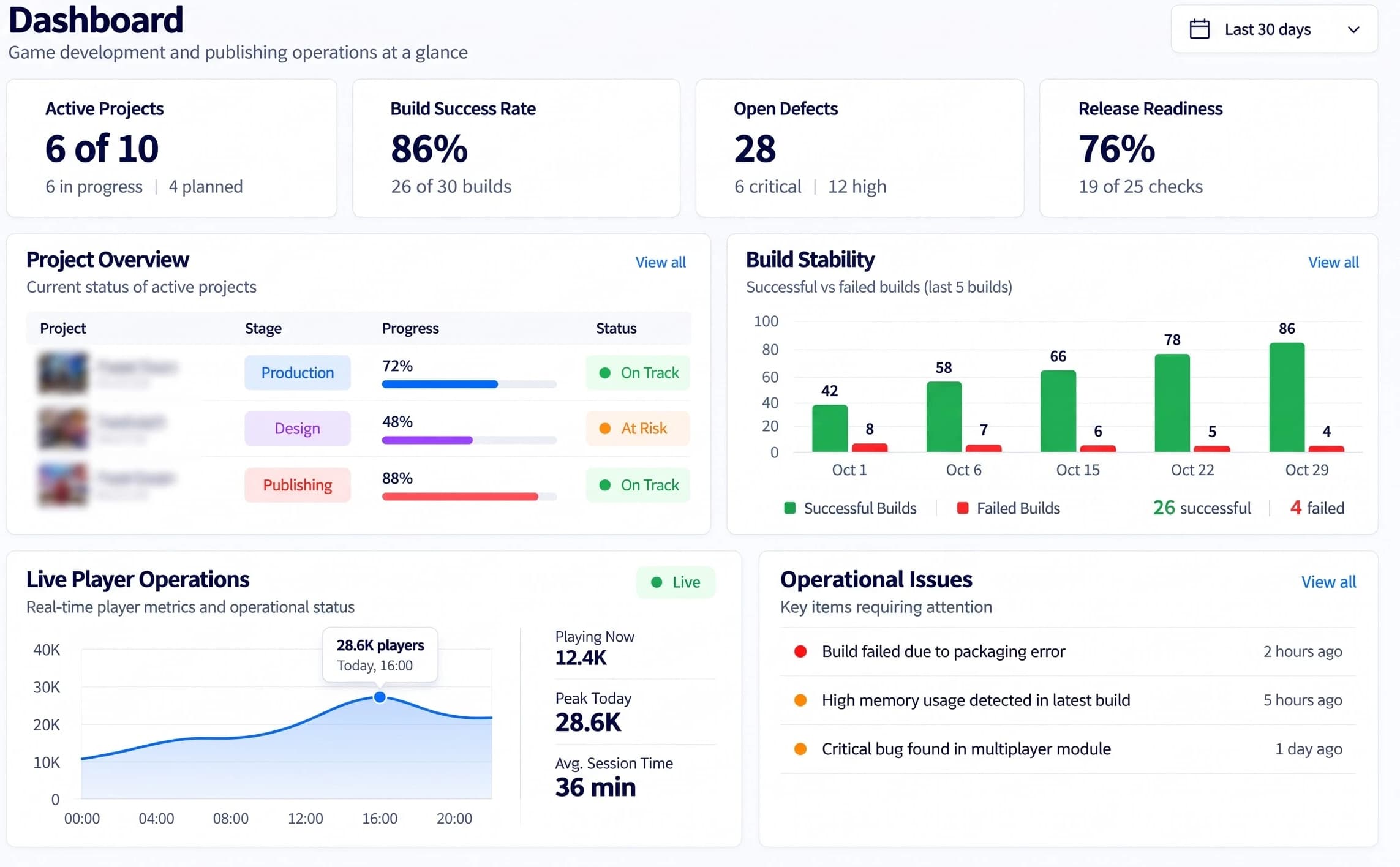
The Dashboard module is the executive operations nerve center that unifies game development and commercial publishing into one real-time command center. Rather than forcing studio directors, executive producers, and department leads to check separate game engines, version control logs, defect trackers, devkits, and storefront consoles, this module synthesizes project velocity, build stability, QA test exceptions, platform certification readiness, and post-launch player telemetry into clear, actionable intelligence—empowering studio leadership to identify bottlenecks early, protect release schedules, and maintain total operational accountability.
Executive Nerve Center
Dashboard
Track studio-wide development velocity, compiler packaging stability, and platform certification compliance from a single real-time console. Filter active milestones by engine branch, inspect concurrent live player counts, and drill into urgent blocker alerts to align department leads on priority fixes before release milestones slip.
Illustrative studio UI. Click pins to open feature explainers, or open full screen.
Studio Dashboard / PS–001FULL SCREEN
Yolsudremik AI Studio Dashboard
Project & Milestone Intelligence
Connects every active game title across all development stages. Automatically reconciles completed features against publisher milestones and delivery schedules, eliminating delivery surprises.
85%
Milestone & Scoping Velocity
Continuous Build & Pipeline Health
Monitors code compilation and asset packaging across Perforce and Git branches. Instantly isolates broken dependencies, shader compiler errors, and engine budget overruns to keep builds playable.
100%
Continuous Build Reliability
Certification & Live Operations Triage
Unifies console compliance standards (Xbox XR, PlayStation TRC, Steamworks) with real-time post-launch player telemetry, surfacing critical defects and server incidents into prioritized fixes.
70%
Accelerated Certification Close
Operational Modules
OPERATIONAL MODULES. CONNECTED STUDIO LIFECYCLE.
From initial publisher scoping and game design to automated build integration, quality certification, and continuing live operations. Each module connects into one unified studio coordination layer.
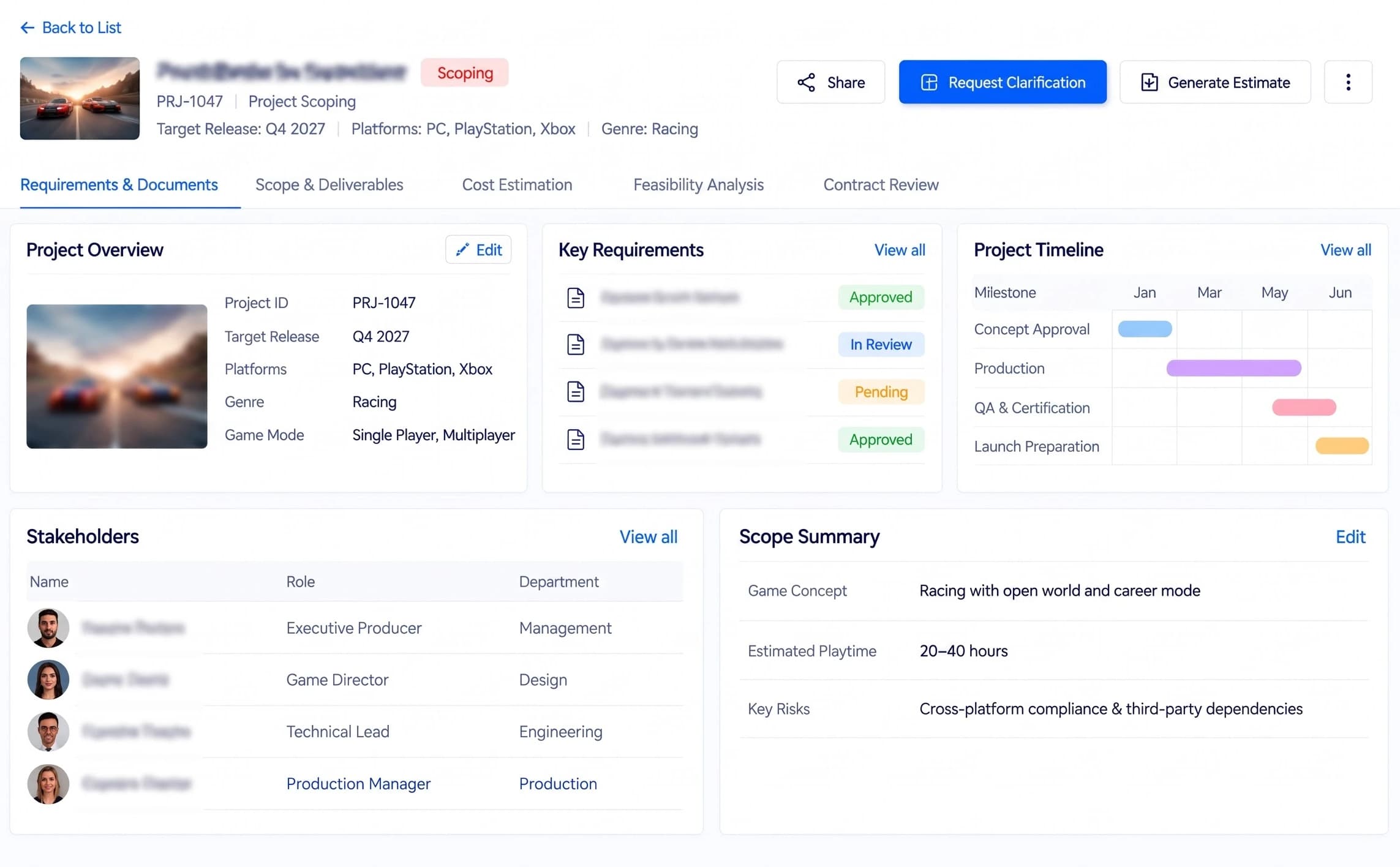
PS–002 · Project Scoping Workspace
Executive Producer & Business Development Lead
Project Scoping
Ingest publisher RFPs and client design briefs to automatically extract deliverable milestones, identify technical constraints, and calculate cross-discipline staffing costs. Simulate timeline scenarios across engineering, art, and audio teams to finalize contractual commitments and prevent unbudgeted feature creep before committing production budgets.
Governed Studio Artifacts: Request for Proposal (RFP), Statement of Work (SOW), Master Development Agreement (MDA), platform specifications, milestone delivery baselines
Requirement ExtractionScope Gap AnalysisLabor Cost EstimationFeasibility AssessmentContract Term Review
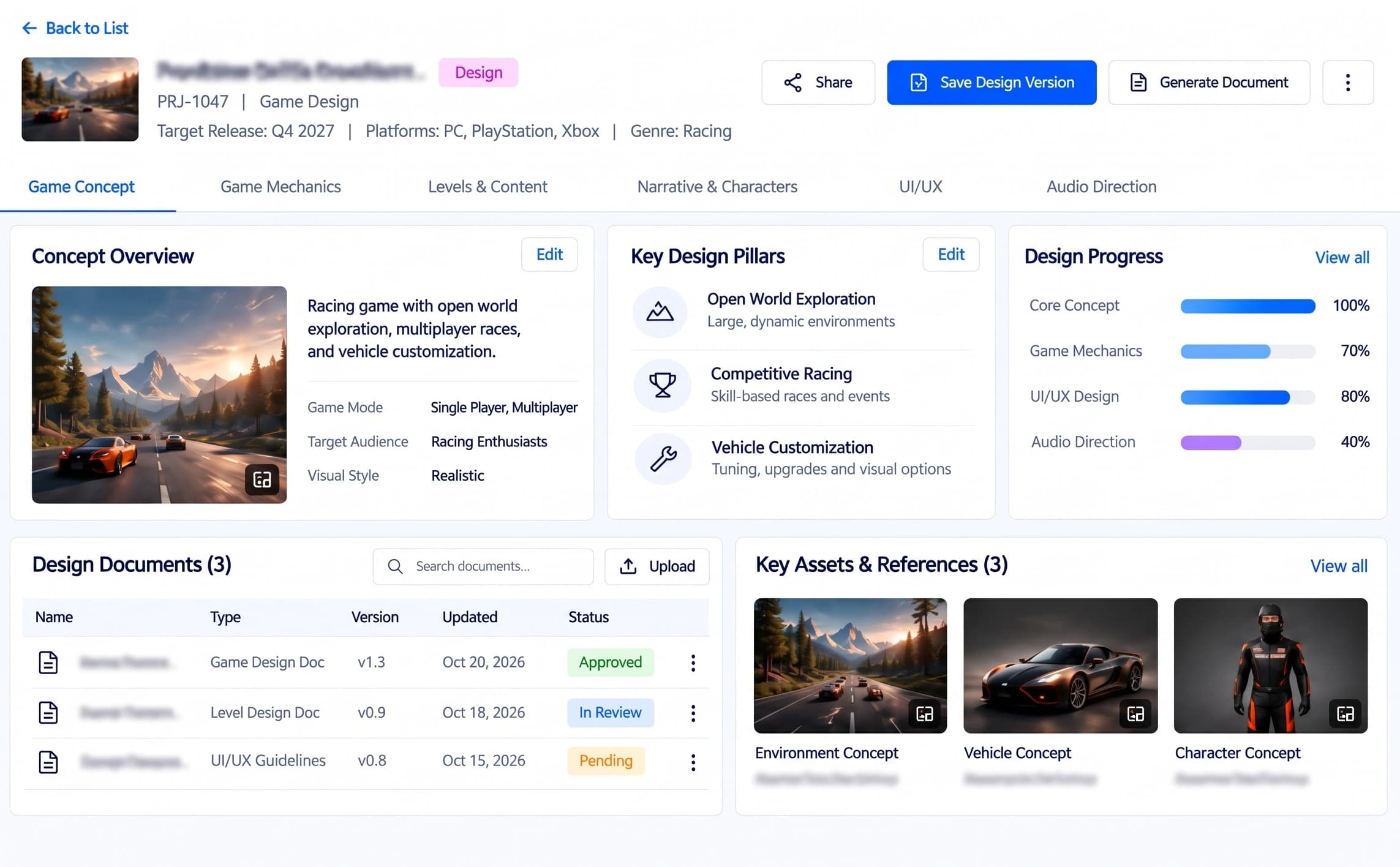
Draft living Game Design Documents and connect narrative dialogue branches directly to technical logic triggers and quest condition graphs. Model in-game economy flows, weapon tuning curves, and character progression against live playtest telemetry to identify balancing exploits and eliminate broken quest dependencies before assets go into production.
Governed Studio Artifacts: Game Design Document (GDD), Technical Design Document (TDD), narrative branching scripts, quest condition graphs, game balance parameters, playtest telemetry
Technical Artist, Gameplay Programmer & Art Director
Game Production
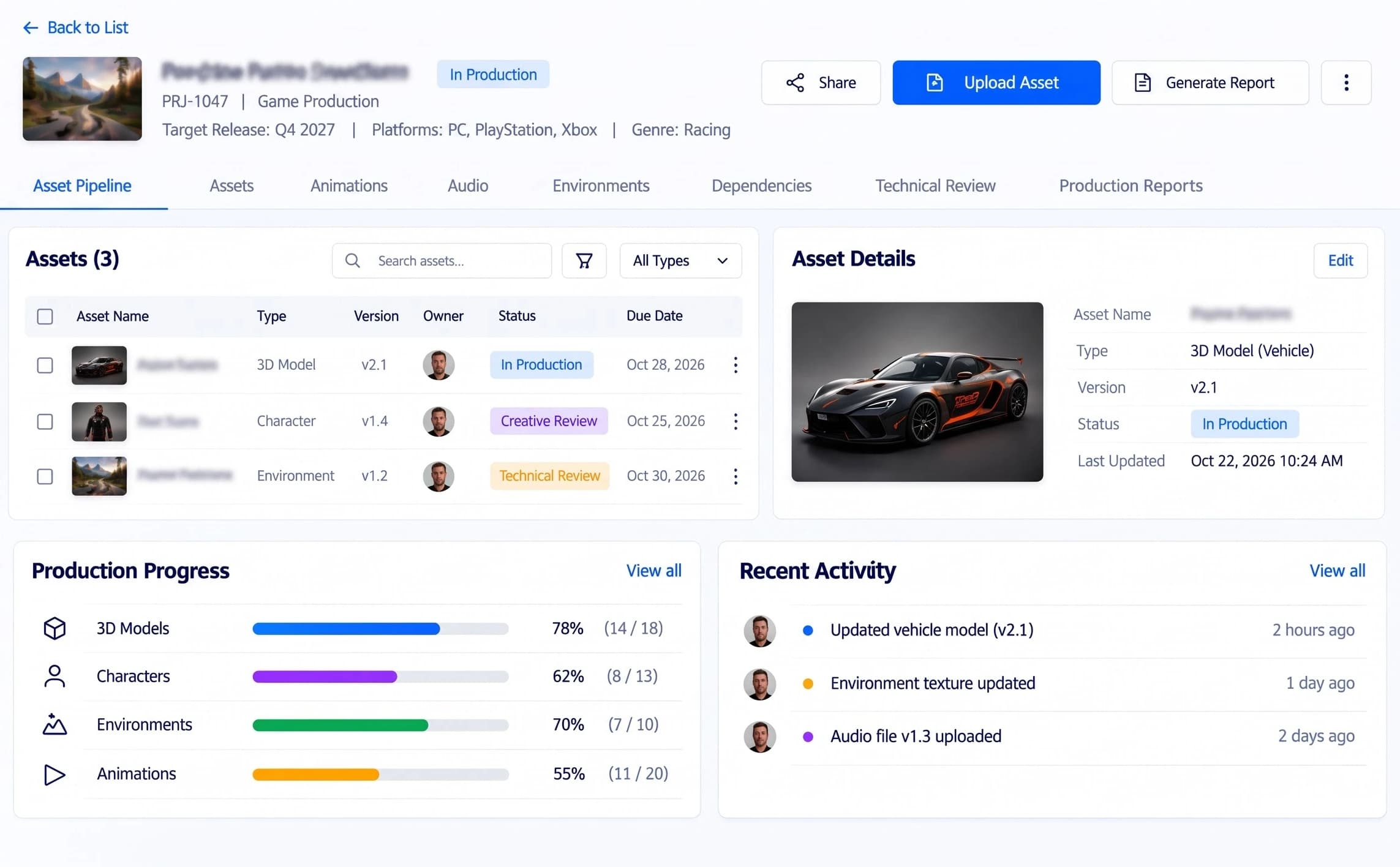
Run 3D meshes, textures, skeletal rigs, and audio files through automated engine budget checks before committing changes to source control. Inspect real-time draw calls, polygon thresholds, and bone hierarchy limits directly in the viewport to catch memory overruns and performance regressions before they degrade game framerates.
Governed Studio Artifacts: C++ and C# source revisions, FBX models, UASSET files, level maps, texture maps, WAV audio, Perforce changelists, technical asset manifests
Build Engineer, Technical Director & Release Engineer
Build Integration
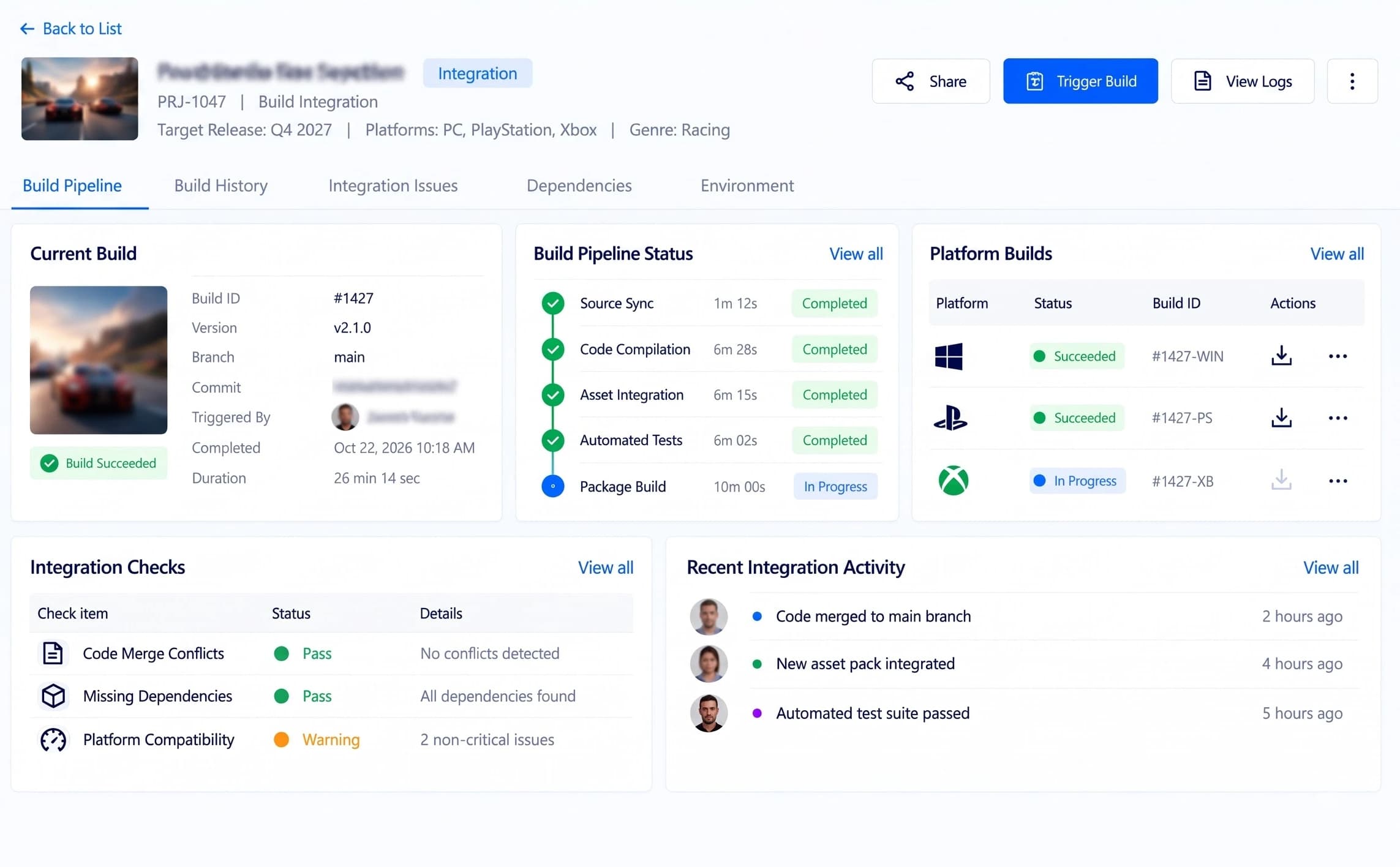
Trigger automated continuous compilation and asset packaging across Perforce and Git branches targeting PC, console, and mobile platforms. When a build fails, inspect AI-diagnosed compiler logs to pinpoint broken dependencies or missing shader assets instantly, verify package checksums, and generate playable release candidates with complete version lineage.
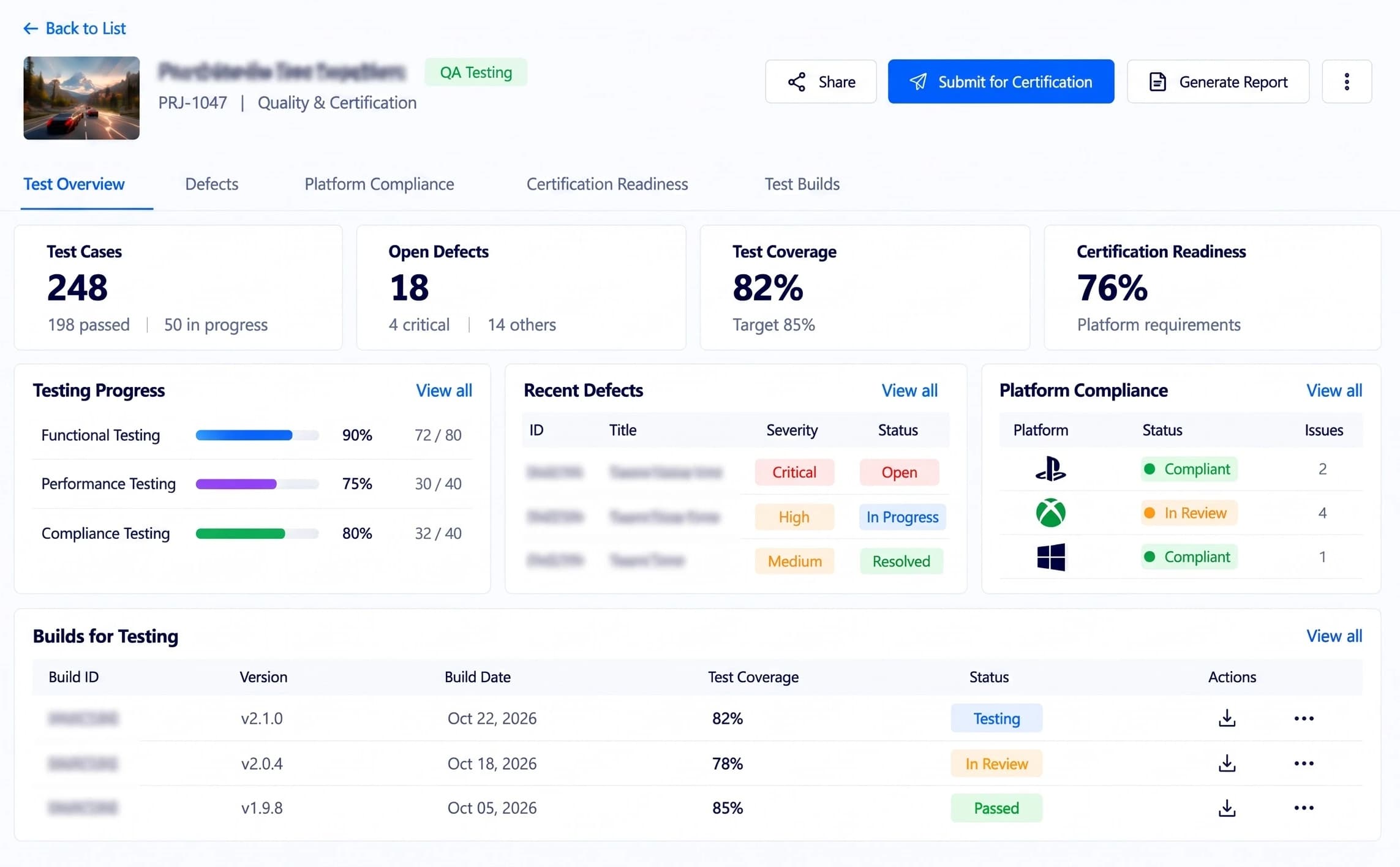
Generate structured test plans from game design mechanics, categorize player defect reports automatically, and group crash memory dumps by call stack signatures. Audit test evidence directly against official console certification requirements—including Xbox XR standards and Steamworks checklists—to detect compliance violations before submitting builds for certification.
Release Manager, Publishing Lead & Marketing Coordinator
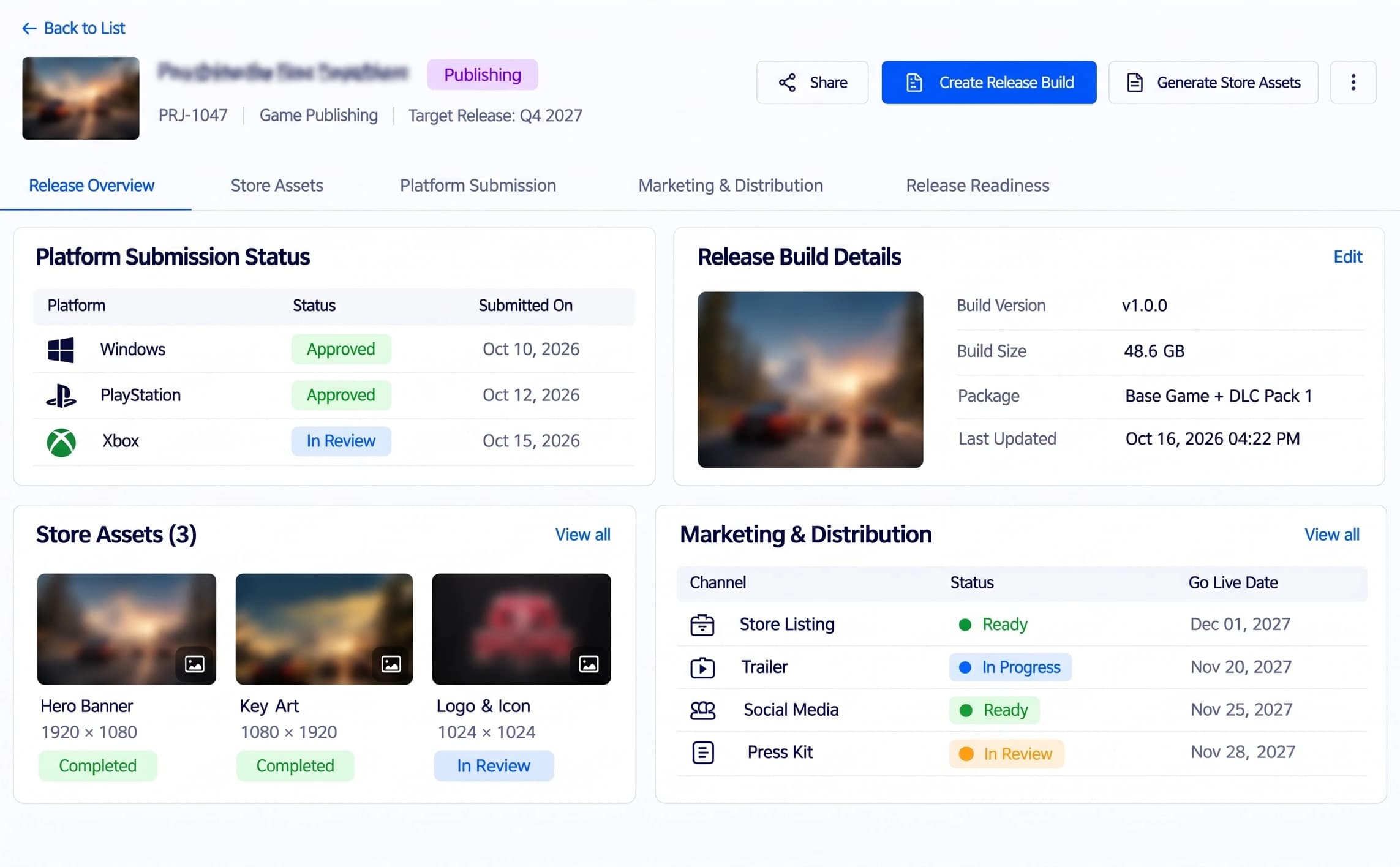
Game Publishing
Coordinate cross-platform submission statuses across Steam, PlayStation, Xbox, and Nintendo storefronts from a unified release matrix. Validate localized store metadata, verify age rating compliance disclosures (ESRB, PEGI, IARC), and match cryptographic package checksums against certified builds to ensure compliant global launches on schedule.
Governed Studio Artifacts: Release candidates, build manifests, package checksums, storefront metadata, age rating certificates, platform submission records, launch authorization sign-offs
Live Operations Lead, Support Lead & Revenue Accountant
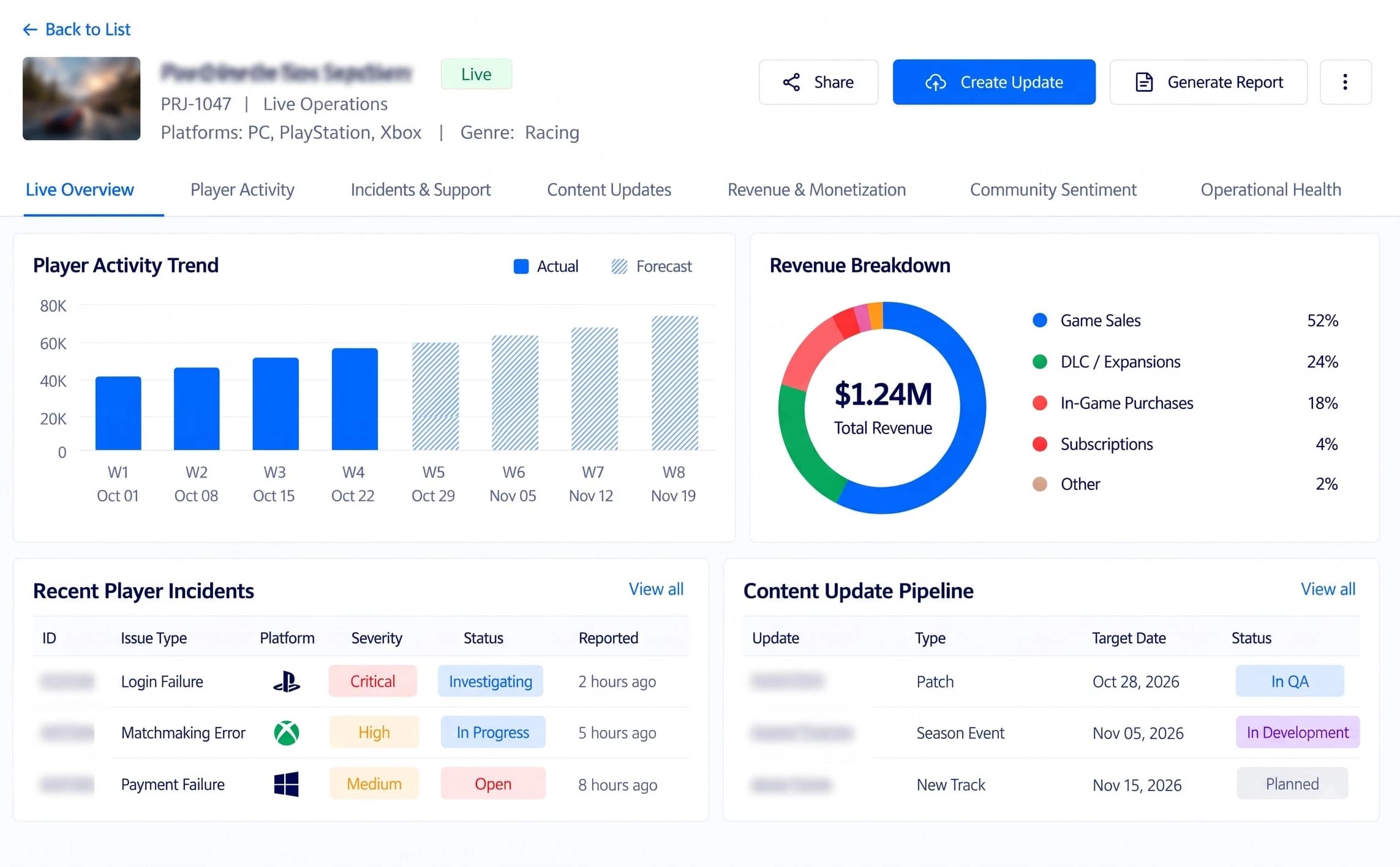
Live Operations & Revenue
Monitor real-time concurrent player metrics, server health telemetry, and customer support ticket surges to detect multiplayer outages or matchmaking anomalies immediately. Route high-priority live defects directly to engineering for emergency hotfixes, and reconcile storefront transaction reports against publisher royalty agreements to verify net studio earnings.
Governed Studio Artifacts: Published releases, player support tickets, crash telemetry, service incidents, patch history, purchase transactions, storefront sales reports, publisher royalty agreements
Note: These providers have documented APIs. They are options for implementation assessment, not confirmed connections in this preview. Supported routing must be agreed and verified during onboarding; additional providers remain roadmap candidates.
Studio Operating Workflow
FROM CONCEPT BRIEF TO LIVE OPERATIONS.
Phase 1
Project Scoping & Game Design
Publisher briefs, client RFPs, and creative concepts enter Project Scoping, where AI extracts technical requirements, flags hidden scope risks, and estimates budgets. In Game Design, teams establish living Game Design Documents (GDD), narrative branching conditions, and player progression mechanics.
01Phase 2
Game Production & Build Integration
Programmers and technical artists build gameplay logic, 3D models, and animations in Game Production under automated polygon and texture budget checks. In Build Integration, validated components are compiled and packaged into reproducible builds with automated failure diagnostics.
02Phase 3
Quality & Certification
QA teams execute automated and functional test suites on devkits in Quality & Certification. The module clusters duplicate defects, analyzes crash memory dumps, and verifies release candidates against official console standards (Xbox XR-001/XR-003, PlayStation TRC, and Steamworks review).
03Phase 4
Game Publishing, Live Operations & Revenue
Release managers coordinate store metadata, rating disclosures (ESRB, PEGI), and package checksums in Game Publishing. Post-launch, Live Operations & Revenue monitors real-time player telemetry, routes emergency patches, and reconciles storefront earnings against publisher agreements.
04
Automated Studio Workflows
Your Video Game Development & Publishing AI agents, run like production systems.
A packaging failure or certification gap needs an engineering workflow, not another chat window.
Workflow A packaging failure or certification blocker occurs on release candidate BUILD-SYN-1842.
Agents Parse compiler logs, cross-reference Xbox XR-001 / Steamworks guidelines, and group duplicate crash signatures.
Tools Engine build manifests, Perforce changelists, Jira QA records, and automated test telemetry.
Execution Assign the root cause to the responsible technical artist or programmer; approval gates the retest.
Outcome A verified, certified release candidate with complete audit lineage from asset commit to platform submission.
Agent workflows are scoped to your studio tools, repository permissions, and human approval policy.
Your existing tools can become part of the AI workflow. These documented APIs are implementation options; this preview does not connect to your accounts.
Version control / assets
Perforce Helix Swarm API
Changelists, branch specifications, and 3D asset revisions sync directly with build manifests and traceability records.
Maintain age-rating information and content disclosures for games before publishing. Store rating records, content descriptions, and approval status for each game and target region.
STEAMWORKS
Steam Store & Build Review
Maintain a simple publishing checklist for Steam store information and game builds. Track required descriptions, screenshots, build versions, review status, and pending corrections before release.
Note: Informational context for certification readiness and publishing workflows. Standards, licensing, and platform obligations must be verified for your title; official certification belongs exclusively to external platform authorities.
Add-ons
Add the hardware your workflow needs.
Generic third-party devices, connected through a defined interface. Compatibility and any additional ingestion work are verified during scoping.
Directly interfaces target console devkits and PC test rigs to intercept unhandled memory dumps, GPU frame-time spikes, and kernel exceptions during automated nightly regression runs. Telemetry streams continuously into the Quality & Certification module to cluster duplicate call stacks, identify performance degradations early, and enforce console platform compliance standards before release candidate submission.
Connection: Documented integration interface
Optical & Inertial Tracking Gateway
Module: Game ProductionZeroMQ / OSC over UDP Stream + C++ SDK
Spatial Motion Capture Sensor Hub
Ingests real-time optical marker telemetry, inertial suit data, and raw actor skeletal transforms directly into the Game Production asset pipeline. The gateway automatically maps joint constraints and deformation hierarchies to engine bone limits, validating performance budgets and preventing broken rig weights before motion-captured animation takes can be checked into studio version control.
Connection: Documented integration interface
Spectrophotometer & Calibration Sensor
Module: Game ProductionUSB HID / WebHID API + ICC Profile Connector
Studio Reference Display Colorimeter
Continuously calibrates studio mastering monitors by sampling ambient illuminance and spectral chromaticity directly at artist workstations. The sensor automatically validates physically based rendering (PBR) texture maps against target engine color space budgets and HDR standards, ensuring diffuse, specular, and emissive materials render consistently across consumer TVs, PC monitors, and mobile displays.
Connection: Documented integration interface
Note: Hardware, installation, and integration are not included in the standard subscription. Additional charges apply based on the hardware selected, integration modules required, and implementation scope.
Studio Subscription
ONE PLATFORM. THE COMPLETE CYCLE.
PS / Studio AccessVideo Game Development & Publishing
Starting at $200/mo
Scoping. Design. Assets. Builds. Quality. Publishing. Live operations. One connected studio operations platform, scoped to your team.
USD subscription. One-time studio onboarding is separate.
Note: AI API usage is charged separately.Clients must recharge their AI credit balance based on their usage.
Studio Onboarding
Onboarding What your onboarding fee covers
A one-time setup for your game studio's design documents, asset pipelines, build integration, and release workflows. Fees are starting points; final scope depends on game engine repositories, Perforce/Git connections, certification requirements, and deployment model.
Setup / 01
Essential
Starting at$1,000+one-time
Studio kickoff and development operations rollout plan
Workspace setup and department lead administrator roles
GDD and TDD specification templates and feature breakdown schemas
Technical asset validation rules and poly-budget thresholds
QA triage board and reproduction completeness checklists
Core build manifest lineage and handoff verification
Studio production handbook and team go-live enablement
Setup / 02Recommended
Plus
Starting at$2,500+one-time
Everything in Essential, plus:
Historical defect migration and regression history import
Two scoped connections to Perforce Helix Core and Jira Software
Custom Xbox XR and Steamworks certification readiness matrix
Automated crash dump grouping and compiler log diagnostics setup
Live training for technical directors, leads, and producers
Guided milestone rollout with a dedicated gaming operations specialist
Setup / 03
Enterprise
Starting at$5,000+one-time
Everything in Plus, plus:
Multi-studio or co-development partner workspace architecture
Bespoke build CI/CD pipeline automation and packaging hooks
Bulk 3D asset metadata indexing and Perforce changelist integration
Custom publisher milestone acceptance and royalty reconciliation logic
Role-specific training across creative, engineering, and QA departments
Dedicated studio implementation manager with contractual milestone SLAs
Two ways to run it. The same subscription.
Cloud (SaaS)
Managed cloud hosting, automatic updates, and continuous backups for studio coordination. Fastest to deploy without provisioning internal servers.
Private / self-hosted
Deploy the identical platform inside your studio's own VPC, AWS/Azure enclave, or air-gapped on-premise infrastructure for confidential unreleased game IP and proprietary gameplay code. The subscription remains unchanged; onboarding scope is tailored to infrastructure requirements.
Studio Knowledge & Notes
BEFORE YOU SHIP YOUR BUILD.
01Does Yolsudremik AI replace our game engine or version control?+
No. The platform is an operational coordination layer. It integrates with existing game engines (Unreal Engine, Unity), source control (Perforce, Git), and digital content creation software, rather than replacing them.
02Does AI make autonomous game balance or certification decisions?+
No. AI assists with diagnostic pattern recognition, requirement extraction, duplicate bug clustering, and platform certification gap analysis. Critical creative, technical, and publishing decisions always require human approval by qualified game designers, technical leads, and producers.
03How does the platform handle unreleased game assets and proprietary source code?+
Source code and binary 3D assets remain in your studio repositories. Yolsudremik AI retains cryptographic hashes, metadata manifests, and build lineage references. Private VPC and self-hosted deployment options are available for air-gapped studio security.
04What is included in the monthly subscription?+
The subscription covers the full eight-module operations platform across project scoping, game design, production, build integration, QA triage, publishing, and live operations. Initial studio onboarding, hardware telemetry bridges, and custom studio connectors are scoped separately.
05Can we prepare evidence for platform certification like Xbox XR and Steamworks?+
Yes. The Quality & Certification module tracks readiness checklists against official platform requirements like Xbox XR-001 Title Stability and Steamworks submission standards, linking reproduction evidence, crash dumps, and build manifests to your release candidate.