
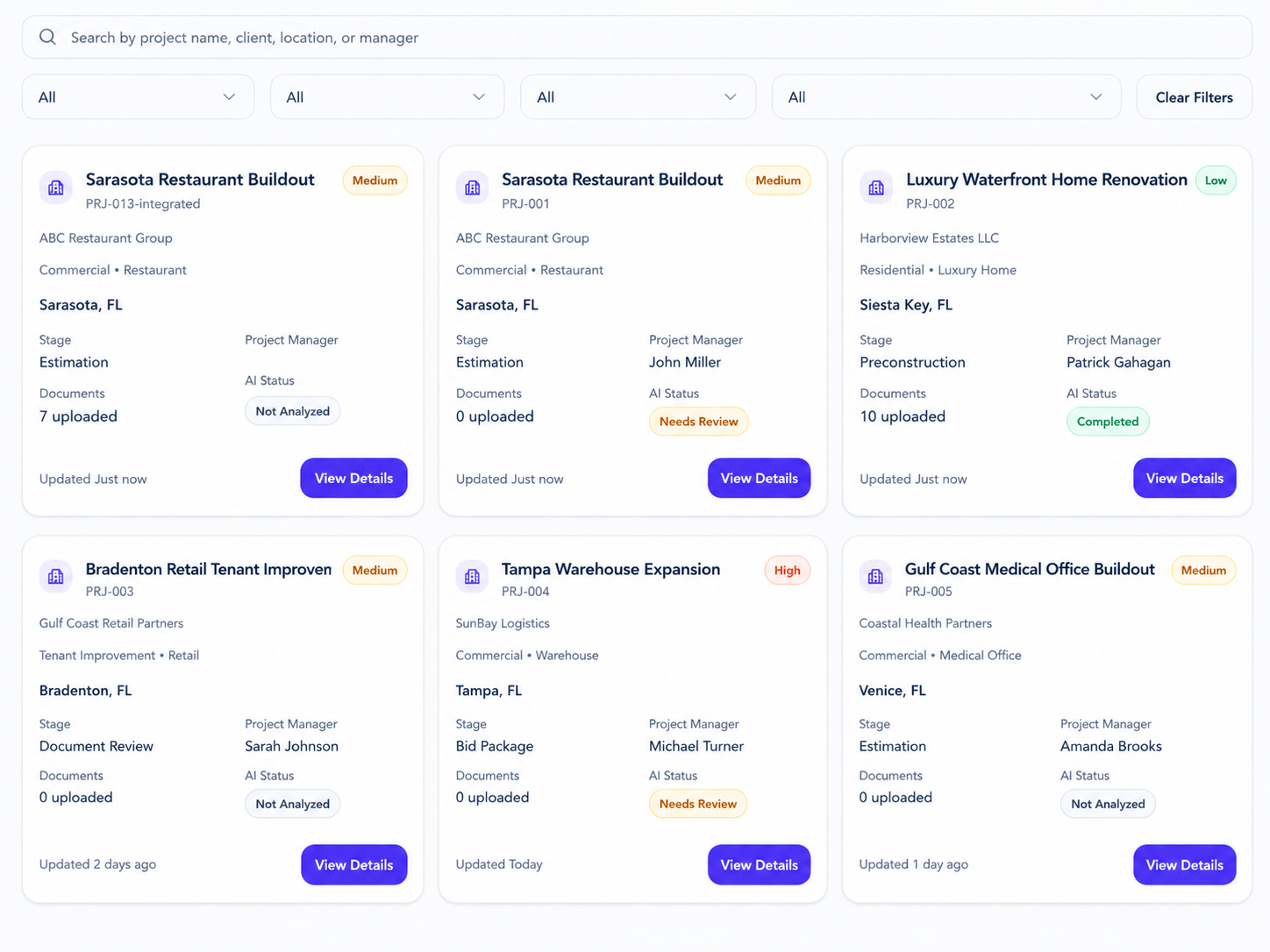
Construct Flow AI is a preconstruction and operations platform built for general contractors who need one connected workflow instead of scattered spreadsheets, email threads, and one-off AI tools. The application walks a project from intake through blueprint understanding, scope and estimating, bid packaging, subcontractor matching, quotes, outbound RFIs to design, final estimates, and field visibility — all inside a single left-sidebar workspace branded as Construct Flow AI. Each module reads and writes shared project context: parsed sheets feed scope extraction, scope feeds the estimator worksheet, intentional pricing gaps route trades into bid packages, and compliance-aware RFIs unblock downstream bidding. AI is used where it adds credibility — document parsing, knowledge-base retrieval with citations, vision analysis of site photos, and grounded drafting — with deterministic fallbacks so demos never break when API keys are missing. Data persists locally in the browser for proof-of-concept demos, charts on the dashboard reconcile with module state, and the storyline is designed so a salesperson can walk a client top to bottom without dead ends. Construct Flow AI is not a generic CRUD app; it is a construction lifecycle narrative where every screen is a transition on the same project, not an isolated calculator.
Blueprint Parser
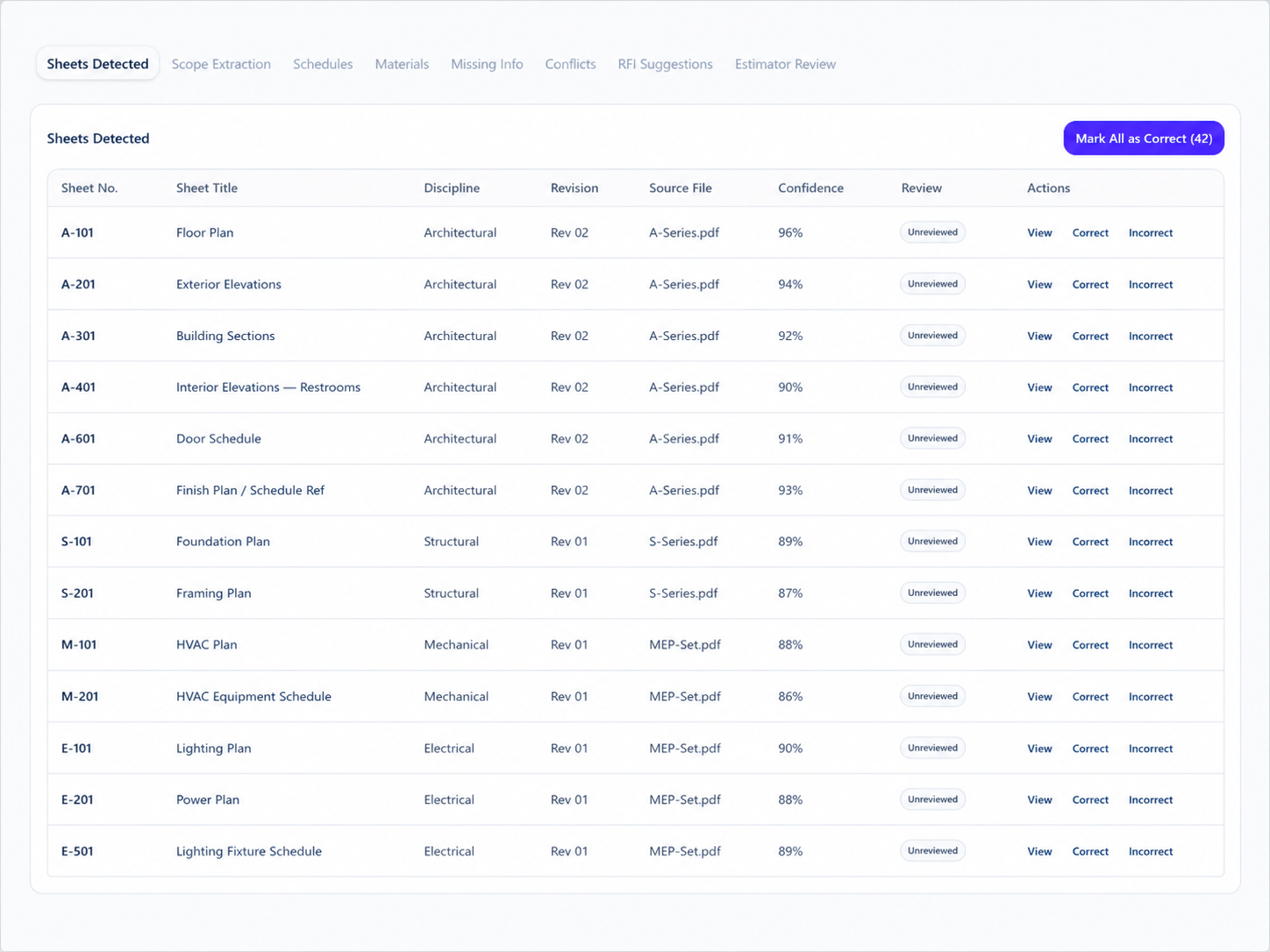
The Blueprint Parser module is where digital plan sets become structured, reviewable intelligence, and the Sheets Detected tab is the first credibility checkpoint in that pipeline. After upload and parsing, ConstructFlow AI auto-labels each drawing sheet with sheet number, title, discipline (Architectural, Structural, Mechanical, Electrical, and related trades), revision, and source PDF — along with a confidence score that tells estimators and PMs where human review is still warranted. The table you see in the product mirrors how teams actually work in preconstruction: they do not jump straight to quantities; they first confirm that A-101 is really the floor plan, that M-101 came from the MEP set, and that Rev 02 is the issue in play. Review actions — View, Correct, Incorrect, and bulk Mark All as Correct — turn AI output into an auditable baseline before scope extraction, schedules, materials, missing-info flags, conflicts, RFI suggestions, and estimator review. That ordering matters commercially: clients trust the demo when they see sheet-level traceability (86–96% confidence in the screenshot) rather than a black-box “AI parsed your job.” Sheets Detected is the foundation layer; everything downstream in Construct Flow AI — scope lines, cost-code mapping, quote-required bid packages — inherits the quality of what was accepted here.
Site Progress
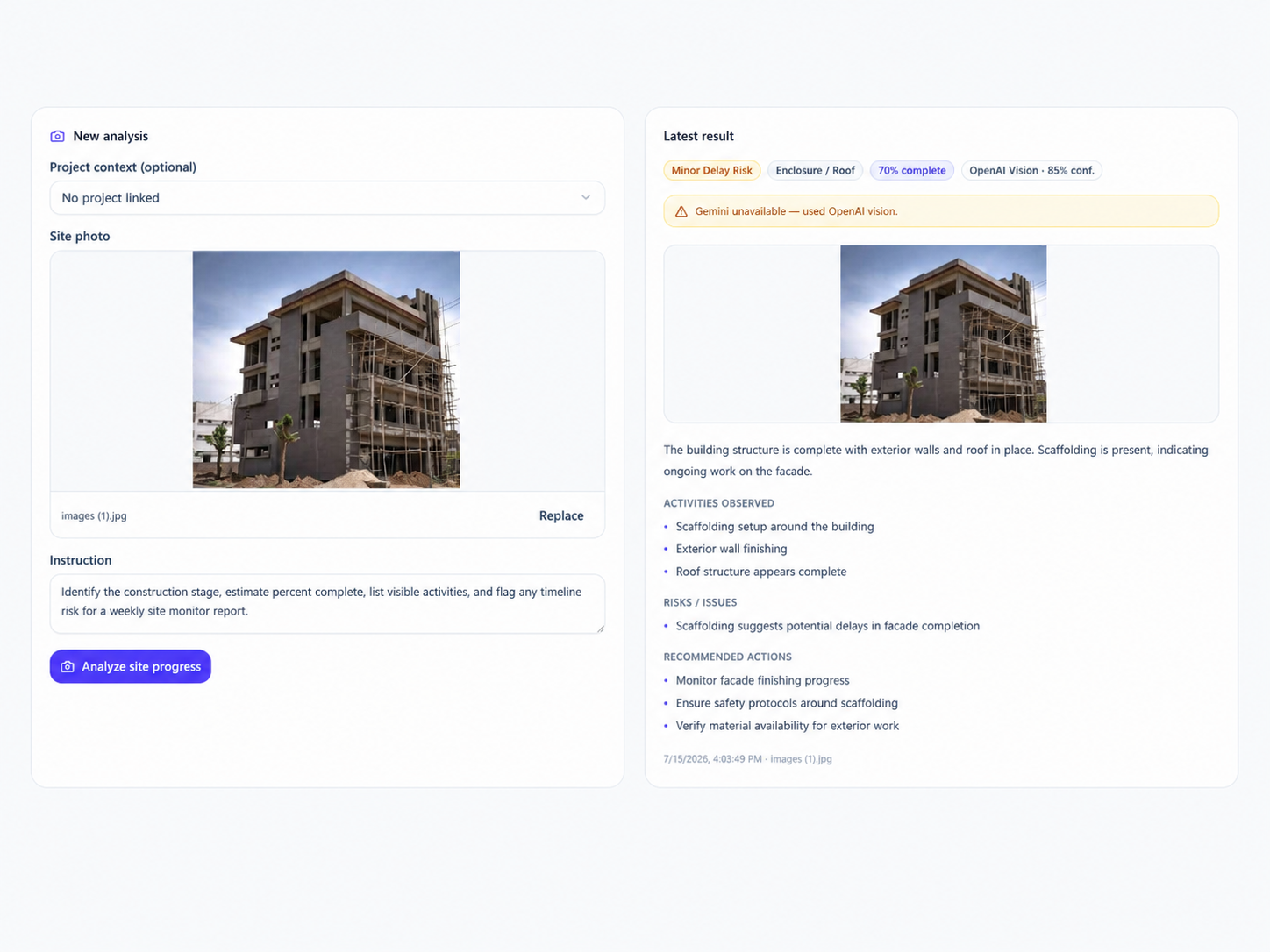
Site Progress is a standalone field module in the same sidebar, aimed at superintendents and PMs who need fast, structured answers from jobsite photos without opening a separate photo app or writing narrative from scratch. The left panel is the intake workspace: optional project context, site photo upload, and a natural-language instruction (defaulting to stage, percent complete, visible activities, and timeline risk for a weekly monitor report). The right panel is the Latest Result — a structured summary, not a chat transcript — with badges for timeline risk, observed stage (for example Enclosure / Roof), percent complete, vision provider, and confidence. The analysis breaks out activities observed, risks or issues, and recommended actions, with history stored locally for comparison across visits. Vision runs through Gemini or OpenAI when keys are available, with a demo-safe fallback when they are not, so sales demos stay reliable. In the screenshot, scaffolding and incomplete facade work drive a Minor Delay Risk call while the roof structure reads largely complete — exactly the kind of qualitative signal executives want beside estimate and bid data. Site Progress does not gate the bid workflow; it complements the preconstruction spine by giving field reality a voice in the same ConstructFlow AI product story.
Technologies Used
- Platform: Next.js, React 19
- AI Models: OpenAI + Google Gemini
- Database: Firebase — Auth, Firestore, Cloud Storage
- Infrastructure: Vercel Edge Network
- Industries: Construction